Cohen sutherland line clippings algorithm, Computer Graphics

Assignment Help:

Cohen Sutherland Line Clippings Algorithm

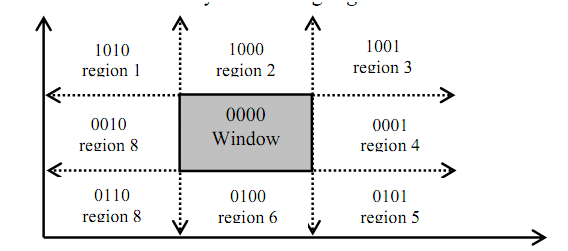
The clipping problem is identified by dividing the region surrounding the window area into four segments Up as U, Down as D, Left as L, Right as R and assignment of number 1 and 0 to respective segments assists in positioning the area surrounding the window. How this positioning of areas is performed can be well determined by understood in following figure.
2465_Cohen Sutherland Line Clippings Algorithm.png

Figure: Positioning of regions surrounding the window

In figure as given above we have noticed that each coding of areas U, D, L and R is done along w.i.t. window region. Since window is neither Left nor Right, neither up nor down so, the respective bits UDLR are 0000; currently see area1 of above figure. The positioning code UDLR is 1010, that is the area1 lying on the position that is upper left side of the window. Hence, area1 has UDLR code 1010 i.e. Up so U=1, not Down so D=0, Left so L=1, not Right so R=0.

The sense of the UDLR code to identify the location of region w.i.t. window is:

1st bit ⇒ Up(U) ; 2nd bit ⇒ Down(D) ;3rd bit ⇒ Left(L) ;  4th bit ⇒ Right(R),

Currently, to perform Line clipping for different line segment that may reside within the window region partially or fully, or may not even lie in the widow area; we utilize the tool of logical ANDing among the UDLR codes of the points lying on the line.

Logical ANDing (^) operation

=>

1 ^ 1 = 1; 1 ^ 0 = 0;

between respective bits implies


Note:


0 ^ 1 = 0; 0 ^ 0 = 0


  • UDLR code of window is 0000 all the time and with respect to this will generate bit codes of other areas.
  • A line segment is observable if both the UDLR codes of the end points of the line segment equal to 0000 that is UDLR code of window area. If the resulting code is not 0000 then, which line segment or section of line segment may or may not be observable

Related Discussions:- Cohen sutherland line clippings algorithm

Phong model or phong specular reflection model, Phong Model or Phong Specul...

Phong Model or Phong Specular Reflection Model It is an empirical model that is not based on physics, although physical observation. Phong observed here for extremely shiny su

Key frames -traditional animation techniques, Key Frames -Traditional Anima...

Key Frames -Traditional Animation Techniques The senior artists go and draw the main frames of the animation, after a storyboard has been laid out. These main frames are frame

What are the advantages of the boundary representation, Advantages of the B...

Advantages of the Boundary Representation (i) This format gives efficient picture generation and easy access to other geometric information. (ii) The changes produced by mos

70, how you doing the graphic?

how you doing the graphic?

What is the use of projection reference point, What is the use of Projectio...

What is the use of Projection reference point?  In Perspective projection, the object positions are transformed to the view plane with these converged projection line and the p

Advantages of scan line algorithm, Advantages of Scan line Algorithm:  ...

Advantages of Scan line Algorithm:   This time and always we are working along with one-dimensional array as: x[0...x_max] for color not a 2D-array like in Z-buffer algorithm.

Bezier cubic curves, Q.   What are Bezier cubic curves? Derive their proper...

Q.   What are Bezier cubic curves? Derive their properties. OR  What are Bezier cubic curves? Derive these properties. Also show that the sum of the blending functions is identical

Orientation dependence - modeling and rendering, Orientation Dependence - M...

Orientation Dependence - Modeling and Rendering The outcomes of interpolated-shading models are dependent of the projected polygon's orientation. Because values are interpolat

Enumerate the use of data goggles- virtual reality, Enumerate the use of Da...

Enumerate the use of Data goggles- Virtual Reality Data goggles/helmets - These use optical systems and display screens which send 3D images to the eyes. Motion sensors mea

Derive the common transformation of parallel projection, Derive the common ...

Derive the common transformation of parallel projection into the xy-plane in the direction of projection d=aI+bJ+cK. Solution: The common transformation of parallel projection

Write Your Message!

Captcha
Free Assignment Quote

Assured A++ Grade

Get guaranteed satisfaction & time on delivery in every assignment order you paid with us! We ensure premium quality solution document along with free turntin report!

All rights reserved! Copyrights ©2019-2020 ExpertsMind IT Educational Pvt Ltd