Calculating variance, Microeconomics

Assignment Help:

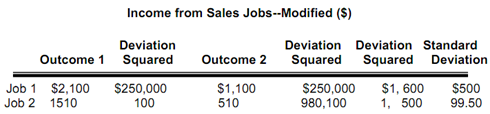
Calculating Variance (σ)
2297_variance.png

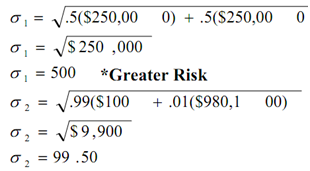
The standard deviations of the 2 jobs are:
1648_standard deviation.png

The standard deviation is used when there are several outcomes instead of only two.

* An Example

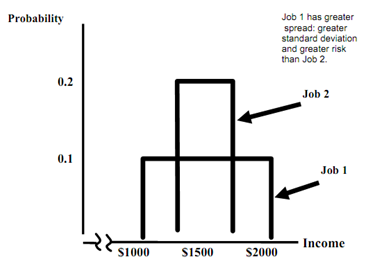
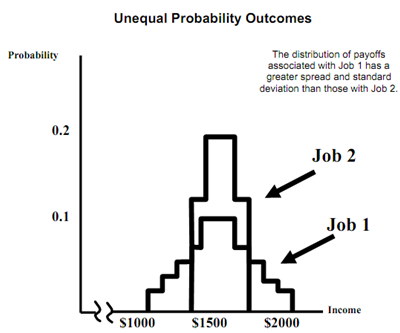
- Job 1 is a job in which income varies from $1000 to $2000 in increments of $100 which are all equally likely.

- Job 2 is a job in which income varies from $1300 to $1700 in increments of $100

that, are all equally likely.
1582_standard deviation1.png

* Outcome Probabilities of Two Jobs

- Job 1: bigger spread and standard deviation

- The peaked distribution: extreme payoffs are much less probable 

*? Decision Making

- A risk avoider would select Job 2: same expected income as Job 1 with less risk.

- Assume that we add $100 to each payoff in Job 1 which makes expected payoff = $1600.
424_unequal probability outcomes.png

2220_unequal probability outcomes1.png

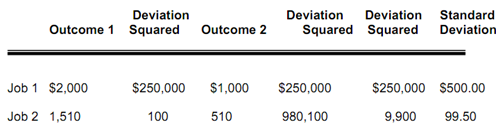
The standard deviation is square root of deviation squared.

*?  Decision making

- Job 1: the expected income is $1,600 and a standard deviation of $500.

- Job 2: the expected income of $1,500 and a standard deviation of $99.50

- Which job?

  • Greater value or less risk?

*? Example

- Suppose a city wants to deter people from wrong parking.

- The alternatives ......
*  Assumptions:

1) Wrong parking saves a person $5 in terms of time spent searching for a parking space.

2) The driver is risk neutral.

3) Cost of apprehension is zero.

*  A fine of $5.01 would deter the driver from double parking.

- Benefit of wrong parking ($5) is less than the cost ($5.01) equals the average benefit which is less than 0.

*  Increasing fine can reduce the cost of enforcement:

- A $50 fine with a .1 probability of being caught results in the expected penalty of $5.

- A $500 fine with a .01 probability of being caught results in the expected penalty of $5.

*  The more risk reluctant drivers are, lower the fine is required to be in order to be effective.


Related Discussions:- Calculating variance

Rational expectations- inflation unemployment trade-off , Rational Expectat...

Rational Expectations- Inflation Unemployment Trade-off : Now, consider what happens if we suppose that workers have rational expectations about the rate of inflation First, th

COST FUNCTION, A firm has two plants. One plant produces according to a cos...

A firm has two plants. One plant produces according to a cost function cl (91) = Yf. The other plant produces according to a cost function c2(y2) = Yg. The factor prices are fixed

Economic chart analysis., show this in a pie chart age = under 20|number of...

show this in a pie chart age = under 20|number of people = 20.90

Economics final paper analysis, This is what this paper should be about ...

This is what this paper should be about 1) In the first paragraph analyze what you most learned from the course to reflect on the statement below. 2) In each separat

Marginal utility., marginal utility is applied on money or not

marginal utility is applied on money or not

Manpower-population ratios, Manpower-Population Ratios In this techniq...

Manpower-Population Ratios In this technique, manpower will not be planned for the economy as a whole. It will be planned for sectors or sub-sectors of an economy. For instanc

The theory of demand :the utility approach, Prove that the utility approach...

Prove that the utility approach and the indifference curve approach yield the same consumer equilibrium.

Write Your Message!

Captcha
Free Assignment Quote

Assured A++ Grade

Get guaranteed satisfaction & time on delivery in every assignment order you paid with us! We ensure premium quality solution document along with free turntin report!

All rights reserved! Copyrights ©2019-2020 ExpertsMind IT Educational Pvt Ltd