Bidirectional search, Computer Engineering

Assignment Help:

Bidirectional Search:

We've concentrated so far on the searches where the point of view for the search is to find a solution, but not the path to the solution. Like any other searches, we know  and notice the solution, and we know the initial state, but we don't know how to get from one to the other, and the point of view the search is to find a path in the given problem. As in these cases, there in addition to searching forward from the initial state, we can sometimes also search backwards from this kind of problem's solution. This is known as the bidirectional search. 

For example we easily understand, consider the 8-puzzle game in this diagram below, where the main point of the game is just to move the pieces around so by that they are arranged in the right hand diagram. It just that in the search for the solution to this puzzle (the given an arbitrary starting to state); you might start off by moving several of the pieces around to get several of them in their end positions in manner. Then, as you reached closer to the solution state, you might that it work backwards: asking yourself, why and how I can get from the solution to where I am stand at the moment, then reversing the main search path. In this issue yes, you've used a bidirectional search. 
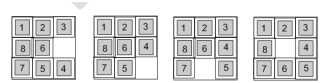
2495_Bidirectional Search.png

Bidirectional search has the main advantage that search can be done in both directions is only required to go for a depth half that is may be of normal searches, and this can often lead to a drastic cut in the number of paths looked at same like this. For this instance, if we were just looking for a path that is come from one town and goes to another through at most six other towns, we can only have to look for the journey through three towns from both directions, we know that which is fairly easy to do, compare to searching all paths through six towns in a normal way of search. 

Unfortunately, it is just often difficult to apply for a bidirectional search because (a) we don't actually sense the solution, only a description of it (b) there may be too many solutions, and we have to choose a few to work backwards from (c) we can't reverse our operators to work backwards from the solution and (d) we have to record all the paths from both sides to check if any two meet at the same point  - this may take up a lot of memory, and considering through both sets repeatedly could take up more computing time.


Related Discussions:- Bidirectional search

Explain about the cathode ray tube technology, Cathode Ray Tube Technology ...

Cathode Ray Tube Technology (CRT) CRT is an analog device that is used by a digital device - computer. The interface between these two devices is described. The major component

Data warehouse, 1) Define a job scheduling strategy that will meet business...

1) Define a job scheduling strategy that will meet business requirement of reporting availability by 6am CST for the following cubes? Show the job scheduling dependencies in a pict

Advantage of crc over simple checksum, Why can CRC detect more errors than ...

Why can CRC detect more errors than simple Checksum? There are two purposes a CRC can identify more errors than a simple Checksum. 1. Since an input bit is shifted by all th

What is fork, What is Fork Clk gets its value after 1 time unit, rese...

What is Fork Clk gets its value after 1 time unit, reset after 10 time units, enable after 5 time units, data after 3 time units. All the statements are executed in parallel.

Register data type as combinational element, Reg data type as Combinational...

Reg data type as Combinational element module reg_combo_example( a, b, y); input a, b; output y; reg y; wire a, b; always @ ( a or b) begin y = a & b; e

What is meant by inferring latches, What is meant by inferring latches, how...

What is meant by inferring latches, how to avoid it? Consider the following: always @(s1 or s0 or i0 or i1 or i2 or i3) case ({s1, s0}) 2'd0: out = i0; 2'd1: out =

Reprographic methods for information distribution, Reprographic Methods ...

Reprographic Methods i) Thermography ii) Dyeline jii) Microfiche iv) Fax In this unit you have learnt that: Used for Methods of reprography are used for the

Define ufd and mfd, Define UFD and MFD.   In the two-level directory st...

Define UFD and MFD.   In the two-level directory structure, every user has own user file directory (UFD). Every UFD has a same structure, but lists only the files of a single u

Name the variable types of c, C provides a wide range of variable types. ...

C provides a wide range of variable types. Normal 0 false false false EN-IN X-NONE X-NONE MicrosoftInternetExplorer4

Write Your Message!

Captcha
Free Assignment Quote

Assured A++ Grade

Get guaranteed satisfaction & time on delivery in every assignment order you paid with us! We ensure premium quality solution document along with free turntin report!

All rights reserved! Copyrights ©2019-2020 ExpertsMind IT Educational Pvt Ltd