Attributes of population, Biology

Assignment Help:

Attributes of Population

The attributes of a population are of two basic types : i) Numerical attributes such as density, mortality (birth rate), mortality (death rate), dispersal and ii) structural attributes like age distribution, dispersion and growth form. Some of the basic attributes of population are briefly described below.

a) Numerical attribute:

Density: number of individuals per unit area.

Natality (Birth rate): the rate at which new individuals are added to a population through reproduction.

Mortality (Death rate): the rate at which individuals are lost from a population by death. ,

Dispersal: the rate at which individuals of a population emigrate or migrate from an area.

b) Structural attributes:

Population growth form: refers to the pattern of population growth. There are two basic patterns of population growth represented by 'T' and "S" shaped growth curves, see Figure for explanation.
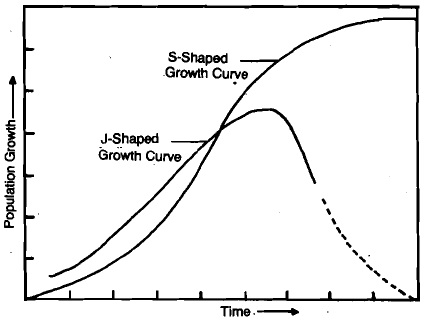
841_atributes of population.jpg


Dispersion:
the pattern of distribution of individuals in space, Age distribution: the proportion of individuals of different age groups in a population.

Now you know some of the more important attributes of a population. It is reasonable to ask: How populations are studied? Do all attributes have equal importance, or are some more important than others? In analysing population, the main attributes studied is the density of the population which depends on four parameters: i) natality, ii) mortality, ii) immigration and, iv) emigration.


Related Discussions:- Attributes of population

Explain about the protein isolates, Explain about the Protein Isolates? ...

Explain about the Protein Isolates? Before we begin our discussion on protein isolates, let us first get to know how protein concentrates differ from isolates. Basically, the t

Write briefly about the bacterial growth curve, Question 1 Write briefly a...

Question 1 Write briefly about the Bacterial growth curve Question 2 Define Virus. List out the general properties and classification of virus Question 3 What is Immunog

Chambers of heart, The ventricles are separated from each other by the inte...

The ventricles are separated from each other by the interventricular septum and the atria are separated from each other by the interatrial septum. The interior of the right atrium

Reproduction, The fusion of two individuals with each acting as a gamete is...

The fusion of two individuals with each acting as a gamete is known as

Post disease as a result -endodontists, If the condition or the post diseas...

If the condition or the post disease as a result of intraradicular infection----> treated conventionally via apex " non-surgical ", ---->Here we have 2 options either coronal

Briefly discuss the salmonella food infection, Briefly discuss the Salmonel...

Briefly discuss the Salmonella food infection. • Salmonella food infection is caused by Salmonella gastroenteritis. Transmitted by faecal contamination of foods. In

Protozoans and cnidarians, compare and contrast the structure of the follow...

compare and contrast the structure of the following: hyrda plain, hydra mematocysts, obelia, amoeba, euglena, paramecium caudatum conjugation, euglena acus.

What do digestive enzymes do to food, What do digestive enzymes do to food?...

What do digestive enzymes do to food? Digestive enzymes suspend food; make food soluble, break large insoluble food molecules into smaller, soluble molecules

Determine the functions of vitamin c, Determine the Functions of Vitamin C?...

Determine the Functions of Vitamin C? The vitamin C is involved in several physiological and biochemical functions in the body. Ascorbate is the biochemically active form of t

Write Your Message!

Captcha
Free Assignment Quote

Assured A++ Grade

Get guaranteed satisfaction & time on delivery in every assignment order you paid with us! We ensure premium quality solution document along with free turntin report!

All rights reserved! Copyrights ©2019-2020 ExpertsMind IT Educational Pvt Ltd