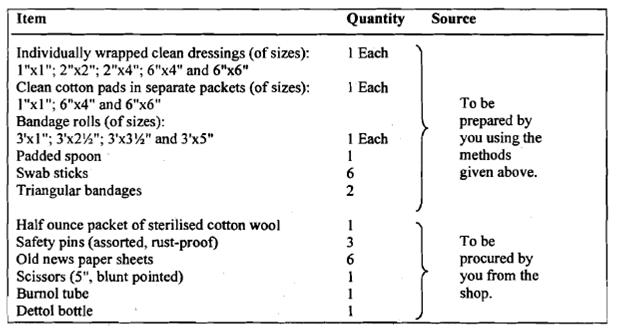
Assembling First Aid Box : Your Counsellor will show you the contents of the first aid box available at the Study Centre. You observe the contents.
As part of this activity, you are also to assemble the contents of first aid box as per Table 3. It is advisable to procure all the first aid materials from medical/general merchant shops. It is also useful to know how to prepare improvised first aid materials such as bandage etc. This practice will help you in offering first aid to a bleeding victim using locally available materials. With this purpose, you will assemble a first aid box which contains both first aid materials (sterilised cotton wool, burn01 tube, safety pins, seissors and dettol bottle) which are to be purchased form medical/general merchant shops and improvised items (clean dressings, clean cotton pads, bandage rolls of various sizes, padded spoon and swab sticks).
Preparation of Improvised Items
A) Using a thoroughly washed and sun-dried old and thin cloth of 1% metres length (which may be cut from an old saree or lungi or muslin cloth), prepare the following four items:
i) Individually wrapped clean dressings: You cut one piece each of following sizes using the thin cloth:
Fold each of them such that the edges are inside and wrap them in clean news papers.
ii) Clean cotton pads in separate packets: You are advised to cut one piece each of clean cotton pads of thickness 112" and sizes 1 "xl", 6"x4" and 6"x6". Cover each from top and below with thin cloth of same size and wrap each with a portion of news paper sheet.
iii) Bandage rolls: Using thin cloth, cut one piece each of sizes 3'x1", 3'x2%" and 3'x3%" and 3'x5" and roll each of them separately.
iv) Padded spoon: A stainlesss steel spoon is to be covered with a clean cotton pad of thickness 112" and size 1 "xl" prepared in (ii) above.
B) Swab sticks: Wash three sticks taken from a fresh broom. Cut them into 6" size. Cover each of them with a bud of cotton.
C) Triangular bandages: Using a thoroughly washed piece of thick cloth (such as khadi), you can prepare triangular bandages. You have to cut diagonally a thick piece of cloth of size 38" x 38" into two pieces. Each piece is a triangular bandage. When not is use, the bandage has to be kept folded.
Using these materials and, others mentioned in Table I1 in Sec. 16.2 of this exercise, assemble the first aid box as per Table 111. Keep these materials in a cardboard box or metal box and paste a green paper on it. A red cross mark may be made on it.
Table 3: The contents of the first aid box to be assembled by each student