 Aristotle described 500 animals in his book "Historia Anamalium", he classified animals into -
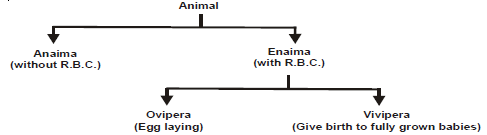
- Later on Carolus Linneus (old name Karl Von Linne) gave popular form of binomial nomenclature in his book
Systema Naturae in 10th eddition. He also classified 4236 animals and used the word class.
Some common examples are -
- Frog = Rana tigrina
- Rat = Ratus ratus
- House fly = Musca domestica
- Species name of two different genra may be same as -
Dog = Canis domesticus
Cat = Felis domesticus
- Trinomial nomemclature was given by Sticklend & Huxley.
- Third name is of sub species.
- Some common examples are -
Indian crow = Corvus splendense splendense
Burma crow = Corvus splendense insoleus
Srilanka crow = Corvus splendense protigatus
- Hackel & Lankester gave rules of classification.
- ICZN was adopted in 1964.
- If suffix is "oideae" it represents order.
- IF suffix is "ideae" it represents family.
- If species name is ended with " i " it shows respect to male.
- If species name is ended with " ae " it shows respect to female.
- Two kingdom classification was given by Lineaus.
Kingdoms are - Plant, Animal
- Three kingdom classification was given by Haeckel.
Kingdom are - Protista, Plant, Animal
- Four kingdom classification was given by Copeland.
Kingdom are - Monera, Protista, Plant, Animal
- Five kingdom classification was given by Whittaker.
Kingdom are - Monera, Protista, Fungi, Plant, Animal
- Monera word given by Haeckel.
- Six kingdom classification was given by Woese, Kandler & Wheelis in 1990.
Kingdom are - Archaeobacteria, Eubacteria, Protista, Fungi, Plant, Animal
- In cladistics living beings are classified with clades (similar to ancestors).
- Storer & Usinger gave modern classification of animals in General Zoology.
- In it 23 phyla are present. 10 phyla are main starts from protozoa to chordata, remainings are minor phyla.
- According to recent work the latest phylum which is discovered as cycliophora (eg. symbion). So total 36 phyla are known, 11 are main phyla.
- Very simple form of animal classification is as under -
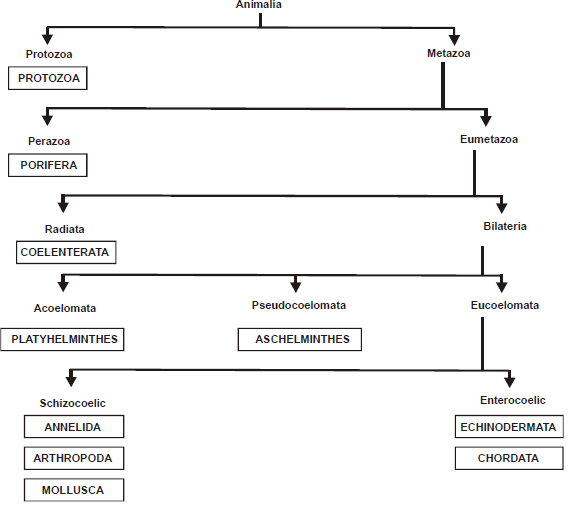
Note :- All schizocoelic animals are protostomia i.e. from blastopore mouth is formed.
All enterocoelic animals are deuterostomia i.e. from blastopore anus is formed. So all animals are grouped in two parts -
Non Chordata & Chordata
- Non Chordata - It includes 9 phyla -
- Protozoa
- Porifera
- Coelenterata
- Platyhelminthes
- Aschelminthes
- Annelida
- Arthropoda
- Mollusca &
- Echinodermata
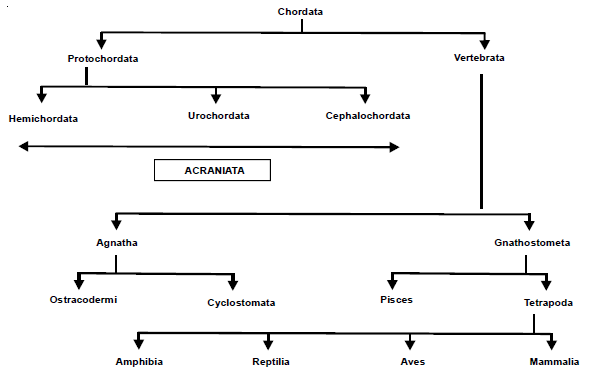
Note :- Invertebrates are those animals which are not vertebrates.
It includes non chordata & protochordata.
Now it is proved that in hemichordata notochord is absent. So hemichordata is excluded from chordata.
Hemichordata is considered as separate group.
Hemichordata also considered as connecting link between echinodermata & chordata.
Email based Biology assignment help - homework help at Expertsmind
Are you searching biology expert for help with Animal Classification - Non Chordata questions? Animal Classification - Non Chordata topic is not easier to learn without external help? We at www.expertsmind.com offer finest service of Biology assignment help and Biology homework help. Live tutors are available for 24x7 hours helping students in their Animal Classification - Non Chordata related problems. We provide step by step Animal Classification - Non Chordata question's answers with 100% plagiarism free content. We prepare quality content and notes for Animal Classification - Non Chordata topic under biology theory and study material. These are avail for subscribed users and they can get advantages anytime.
Why Expertsmind for assignment help
- Higher degree holder and experienced experts network
- Punctuality and responsibility of work
- Quality solution with 100% plagiarism free answers
- Time on Delivery
- Privacy of information and details
- Excellence in solving biology questions in excels and word format.
- Best tutoring assistance 24x7 hours