Static chart diagrams, DOT NET Programming

Assignment Help:

Describe all elements in Static Chart diagrams.
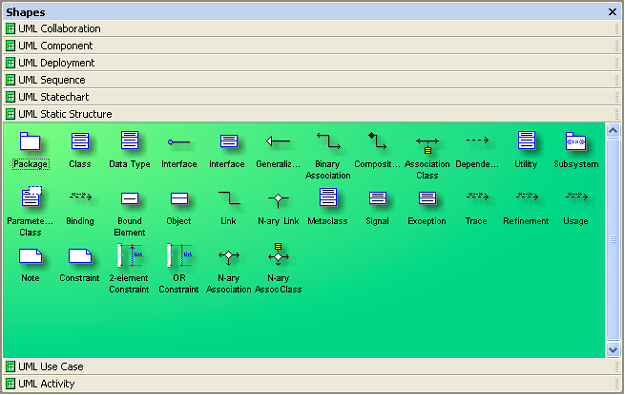
2311_static chart diagram.png

Package: - The Package logically groups element of a UML model.

Class: - The Class describes all set of objects with similar structure, relationships, and behavior.

Data Type: - A data type is an instance of the DataType metaclass defined in the UML metamodel. A data type declares a type of class attribute. The Data type is available as a string; you can include it when you define attributes for all other elements in a model.

Interface: - The Interface specifies the externally operations of a class, package, component, or other element without specifying internal structure.

Generalization: The Generalization is a relationship b/w a specific element and a general element, such that the specific element is fully consistent with the general element and includes the additional information (like attributes and associations). For e.g., the classes Bike, Car,  Cycle can all be specific elements of a more general abstract class element named as vehicle.

Binary Association: - It is a relationship between 2 classes.

Composition: - A composition is a form of aggregation which indicates that a part may belong to only one whole and that the lifetime of the whole determines the lifetime of the part.

Dependency: - It Shows relationship between two elements.

Utility: - Whatever the Attributes and operations you define for a utility become global variables & procedures.

Subsystem: - The Subsystem is a package that contains the contents of the entire system or an entire model within the system.

Parameterized class: - This is a template that describes a class with one or more unbound formal parameters.

Binding: - It is a kind of dependency which indicates a binding of parameterized class or template, parameters to actual values to create a bound, or no parameterized, element.

Bound element: - The Parameters of the parameterized class are bound to actual values.

Object: - It Represents instance of a class.

Link: - It Represents Links between objects.

N-ary Link: - Shows link between an objects.

Meta-Class: - Whose instances are classes.

Signal: - It specifies the stimulus between classes for which there is no reply. It is an element that can be generalized and is defined independently of the classes handling the signal.

Exception: - Signal rose because of the bad execution.

Trace: - It indicates historical relationship between two elements.

Refinement: - The Refinement is a kind of dependency which indicates a historical or derivation relationship between 2 elements with a mapping between them.

Usage: - The Usage is a kind of dependency which indicates that one element requires the presence of another element for its correct implementation or functioning.

2-Element Constraint: - It represents a constraint on two classes or associations.

OR constraint: - It represents an OR constraint on two classes or associations.


Related Discussions:- Static chart diagrams

Web page parsed-manipulated and scraped, I have a page that I require a few...

I have a page that I require a few pieces of data to be pulled out of. The page is such that it needs interaction; there is a little bit of data entry to get the needed data, and t

How does output caching work in asp.net, How does output caching work in AS...

How does output caching work in ASP.NET?    Output caching is a powerful method that enhances request/response throughput by caching the content generated from dynamic pages. O

How do you implement server-side include directives, Question: (a) How...

Question: (a) How do you implement the following in ASP.NET: (i) Server-side Comments (ii) Server-side Include Directives. (b) (i) Give two reasons why the IsPostBack

Significance of finalize method in .net, What is the significance of Finali...

What is the significance of Finalize method in .NET? The .NET Garbage collector does atmost all clean up activity for your objects. But unmanaged resources (like - Windows API

What is the difference between vb6 and vb.net, What is the difference betwe...

What is the difference between VB6 and VB.Net? VB6 1.       It is Object-based Language 2.       It Does not support Threading 3.       Not powerful Exception handli

Explain synchronous postback and asynchronous postback, What is the differe...

What is the difference among synchronous postback and asynchronous postback? The difference between synchronous and asynchronous postback is as follows: Asynchronous postbac

Vb.net test taker, hello,i want to ask that i have to make a test taker ju...

hello,i want to ask that i have to make a test taker just like a quiz in vb.net which should b like mcq''z one...it must contain a connectivity with database of oracle or MS access

Explain the concept of destructor, Explain the concept of destructor? A...

Explain the concept of destructor? A destructor is a special method for a class and is requested automatically when an object is finally destroyed. The name of the destructor i

Which command-line tool generates code and mapping, Which command-line tool...

Which command-line tool generates code and mapping for the LINQ to SQL component of .NET Framework? The SqlMetal.exe command-line tool generates code and map the LINQ to SQL co

Comparison of asp.net session with classic asp session, What are ASP.NET se...

What are ASP.NET session and compare it with classic ASP session The ASP.NET session caches per user session state. It basically uses "HttpSessionState" class. The limitatio

Write Your Message!

Captcha
Free Assignment Quote

Assured A++ Grade

Get guaranteed satisfaction & time on delivery in every assignment order you paid with us! We ensure premium quality solution document along with free turntin report!

All rights reserved! Copyrights ©2019-2020 ExpertsMind IT Educational Pvt Ltd