Sketch a graph comparing the fcc class, Electrical Engineering

Assignment Help:

a) In the United States, the Federal Communications Commission (FCC) is charged with the regulation of radio and wire communication (FCC part 15). It basically sets limits on the radiated and conducted emissions of a digital device.

i) The FCC further breaks the digital device class of products into Class A and Class B. Briefly detail the markets for which class A and class B products are marketed.

ii) Would you consider a network server to be a class A device, or class B device with regards to the regulatory tests that it must comply with? Why?

iii) Would you consider a $1000 high-speed laser printer a class A or class B digital device with regard to the regulatory tests it must comply with? Why?

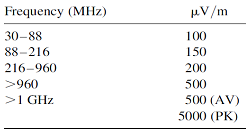
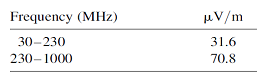
b) The FCC radiated limits for class B Equipment, measured at 3m is given in table 1. Similarly, the CISPR 22 radiated emission limits for class B ITE equipment, measured at 10m, is given by table 2.

Table 1: FCC radiated emission limits for class B, measured at 3m.
1206_Sketch a graph comparing the FCC Class.png

Table 2: CISPR 22 Radiated emission limits for class B ITE equipment measured at 10m.
42_Sketch a graph comparing the FCC Class1.png

i) For all the frequencies listed in tables 1 and 2, provide the value of the limits in dBμV.

ii) Sketch a graph comparing the FCC Class B and the CISPR Class B radiated limits up to 1 GHz. Use dBμV values and assume a distance of 10 meters is taken as reference. List the range of frequencies for which the FCC is more stringent and the range of frequencies for which the CISPR is more stringent.


Related Discussions:- Sketch a graph comparing the fcc class

Determine the motor speed at a specific line current, Q. A dc series motor ...

Q. A dc series motor operates at 750 r/min with a line current of 100 A from the 250-V mains. Its armature-circuit resistance is 0.15  and its series-field resistance is 0.1 . As

Solve for the time-domain forced response of the resultant, Consider an RLC...

Consider an RLC series circuit excited by v(t) = V m cos ωt in the time domain. By using superposition, solve for the time-domain forced response of the resultant current through

Wcdma, what is that mean and explain

what is that mean and explain

Minimize f in a pos form and obtain a possible realization, Q. The truth ta...

Q. The truth table for F(A,B,C) = Mi (0, 1, 6, 7) is as follows: (a) Express F in a canonical product-of-sums form. (b) Minimize F in a POS form and obtain a possible re

Use delta-wye transformation for network reduction, Use delta-wye transform...

Use delta-wye transformation for network reduction and determine the current through the 12- resistor in the circuit of Figure(a).

Sphl load stack pointer with hl instruction, SPHL Load Stack  pointer with...

SPHL Load Stack  pointer with HL Instruction This instruction  copies  the contents of HL register  pair  the stack pointer register. The instruction format is             S

Second Order Precesses, A second-order process with one pole at the origin ...

A second-order process with one pole at the origin has the transfer function 3/(s(2s + 1)) Find the output as a function of time, for a unit step input change. Sketch the expected

Calculate the amplitude and the frequency of the sine wave, (a) The key el...

(a) The key elements of a protocol are the syntax, semantics and timing. Give a brief explanation of each of these key elements. (b) A file contains 4 million bytes. Compare

Inductive logic programming, Inductive Logic Programming : Now here ha...

Inductive Logic Programming : Now here having studied a non-symbolic approach to machine learning on Artificial Neural Networks then we return to a logical approach, namely In

Matlab, fast decoupled program

fast decoupled program

Write Your Message!

Captcha
Free Assignment Quote

Assured A++ Grade

Get guaranteed satisfaction & time on delivery in every assignment order you paid with us! We ensure premium quality solution document along with free turntin report!

All rights reserved! Copyrights ©2019-2020 ExpertsMind IT Educational Pvt Ltd