Single point perspective transformation, Computer Graphics

Assignment Help:

Single Point Perspective Transformation - Viewing Transformations

In order to derive the particular point perspective transformations beside the x and y-axes, we construct figures (19) and (20) as the same to the Figure 18, although with the consequent COP's at E(-d,0,0) and E(0,-d,0) on the -ive x and y-axes respectively.

131_Single Point Perspective Transformation.png

The parametric equation of an l i.e. line EP, starting by E and passing through P is:

E+t(P-E)  0

=(-d,0,0)+t[(x,y,z)-(-d,0,0)]

=(-d,0,0)+t[x+d,y,z]

=[-d+t.(x+d), t.y, t.z]

Point P' is acquired, while t=t*

There is, P'=(x',y',z') =[-d+t*.(x+d), t*.y, t*.z]

Because, P' lies on X=0 plane shows -d+t*.(x+d)=0 must be true, which is t*=d/(x+d) is actual.


Hence, x'=-d+t*(x+d)=0

         y'=t*.y=y.d/(x+d)

         z'=t*.z=z.d/(x+d)

Hence P'=( 0, y.d/(z+d), z.d/(x+d))

          = (0,y/((z/d)+1), z/((x/d)+1))

In terms of Homogeneous coordinate system as P'=(0,y,z,(x/d)+1). The above equation can become in matrix form that is:388_Single Point Perspective Transformation 2.png
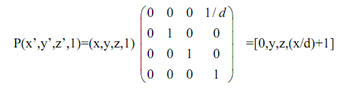
=[0,y/((z/d)+1), z/((x/d)+1),1] -------- (5)

is, P'h = Ph.Pper,x  --------------------------------(6)

Here Pper,z    in equation (5) implies the particular point perspective transformation w.r.t. x-axis.

Thus, the ordinary coordinates projected point P' of a agreed point P of a particular point perspective transformation with respect to the x-axis as:

(x', y',z',1)= [0,y/((z/d)+1), z/((x/d)+1),1] which has a center of projection at [-d,0,0,1] and a vanishing point assigned on the x-axis at [0,0,0,1]

As the same, the particular point perspective transformation w.r.t. y-axis is consequently:
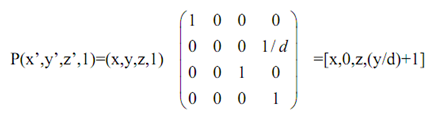
687_Single Point Perspective Transformation 3.png

=[x/((y/d)+1),0, z/((y/d)+1),1] That is, P'h = Ph.Pper,y  -----------------------------(7)

Here Pper,y  in equation (5) implies the particular point perspective transformation w.r.t. y-axis.

Hence, the ordinary coordinates as projected point P' of a given point P of a particular point perspective transformation w.r.t. y-axis that is:

(x',y',z',1)=[x/((y/d)+1),0, z/((y/d)+1),1] which has a center of projection at [0,-d,0,1] and a vanishing point assigned on the y-axis at [0,0,0,1].


Related Discussions:- Single point perspective transformation

#, normal vector

normal vector

Bezier curves - modeling and rendering, Bezier Curves - Modeling and Render...

Bezier Curves - Modeling and Rendering Bezier curves are utilized in computer graphics to turn out curves which display reasonably smooth at all scales. Such spline approximat

What is multimedia, Question 1 What is Multimedia? Explain sound multimedi...

Question 1 What is Multimedia? Explain sound multimedia element Question 2 Explain any three elements of drawings Question 3 Explain any three types of drawing Quest

Important points for key frame systems - computer animation, Important poin...

Important points for Key Frame Systems - Computer Animation In key frame systems the "in-between" "tweening" or frames can be created from the specification of two or more key

Lamberts cosine law - diffuse reflection, Lamberts Cosine Law - Diffuse Ref...

Lamberts Cosine Law - Diffuse Reflection "LAMBERTS COSINE LAW" specify that the radiant energy from any minute surface area dA in any direction θ relative to the surface usual

Mpeg-2 , MPEG-2 : MPEG-2 that is Moving Picture Experts Group format 2 is ...

MPEG-2 : MPEG-2 that is Moving Picture Experts Group format 2 is the standard used through DVD and is of a much higher quality than MPEG- 1. This format gives for 720 x 480 resolu

Low level techniques or motion specific, Low Level Techniques or Motion Spe...

Low Level Techniques or Motion Specific These techniques are utilized to control the motion of any graphic element in any animation scene completely. These techniques are also

Application of coherence in visible surface detection method, explainapplic...

explainapplication of coherence in visible surface detection method

2-d and 3-d transformations, 2-D and 3-D Transformations Previously, w...

2-D and 3-D Transformations Previously, we have presented approaches for the generation of polygonal regions and lines. We identified that once the objects are produced, the v

Gks, explain about gks

explain about gks

Write Your Message!

Captcha
Free Assignment Quote

Assured A++ Grade

Get guaranteed satisfaction & time on delivery in every assignment order you paid with us! We ensure premium quality solution document along with free turntin report!

All rights reserved! Copyrights ©2019-2020 ExpertsMind IT Educational Pvt Ltd