Representing sparse matrix in memory using array, Data Structure & Algorithms

Assignment Help:

Q. What do you understand by the term sparse matrix? How sparse matrix is stored in the memory of a computer? Write down the function to find out the transpose of a sparse matrix using this particular representation.                                                                                                             

Ans.

Sparse Matrix is described below

A m x n matrix A would be a sparse if most of its elements are zero. A matrix that is not sparse is known as dense matrix.

Representing Sparse Matrix in Memory Using Array is described below

In an array representation an array of triplets of type < row, col, element> is used to store non-zero elements, where 1st field of the triplet is used to trace row position second to record column and the 3rd to record the non zero elements of  sparse matrix.

In addition, we are required to record the size of the matrix ( i.e. number of rows and the number of columns) and non zero elements of array of triplets are used for this purpose where the 1st filed saves the number of rows and the 2nd field saves the number of columns and the third field saves the number of non zero elements. The remaining elements of the array saves matrix on row major order. The array representation will be

[2 * (n+1) * size of (int) + n*size of(T)] bytes of memory where n is the number of non-zero elements and T is the data type of the element.

Ex: consider a 5*6 sparse matrix which is written below
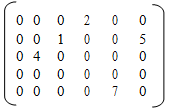
1713_sparse matrix2.png 

Array Representation of Sparse Matrix is given below
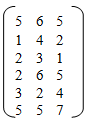
1754_sparse matrix3.png

Here n = 5 but the size of array is 6 as first row saves the order of array along with a number non-zero elements.

Memory declaration will be as followsas shown below

# define Max 50 struct triplet

{   int row;

int col;

float element;

}

struct triplet sparse_mat [MAX];

sparse matrix represented as above

[n is the number of non zero elements in array]

for I= 1,2,...n+1 temp = a[I].row a[I].row= a[I].col a[I].col = temp endfor.


Related Discussions:- Representing sparse matrix in memory using array

Preorder - postorder and inorder, 1) preorder, postorder and inorder 2) ...

1) preorder, postorder and inorder 2) The main feature of a Binary Search Tree is that all of the elements whose values is less than the root reside into the nodes of left subtr

Red-black tree after insertion, The above 3 cases are also considered conve...

The above 3 cases are also considered conversely while the parent of Z is to the right of its own parent. All the different kind of cases can be illustrated through an instance. Le

Array implementation of a dequeue, If a Dequeue is implemented via arrays, ...

If a Dequeue is implemented via arrays, then this will suffer with the similar problems which a linear queue had suffered. Program 8 gives the array implementation of Dequeue.

Explain b- tree, B- Tree  A B-tree of order m is an m-way true in which...

B- Tree  A B-tree of order m is an m-way true in which  1)  All leaves are on the similar level 2)  All internal nodes except the root have at most m-1(non-empty) childre

Binary search tree bst, Describe Binary Search Tree (BST)? Make a BST for t...

Describe Binary Search Tree (BST)? Make a BST for the given sequence of numbers. 45, 36, 76, 23, 89, 115, 98, 39, 41, 56, 69, 48 Traverse the obtained tree in Preorder, Inord

Merging 4 sorted files containing 50, Merging 4 sorted files having 50, 10,...

Merging 4 sorted files having 50, 10, 25 and 15 records will take time  O (100)

Applications of b-trees, A database is a collection of data organized in a ...

A database is a collection of data organized in a manner that facilitates updation, retrieval and management of the data. Searching an unindexed database having n keys will have a

State the output of avaerage value of numbers, Draw trace table and determi...

Draw trace table and determine output from the subsequent flowchart using below data:  X = 5, -3, 0, -3, 7, 0, 6, -11, -7, 12

A full binary tree with 2n+1 nodes, A full binary tree with 2n+1 nodes have...

A full binary tree with 2n+1 nodes have n non-leaf nodes

Recursive implementation of binary tree traversals, There are three typical...

There are three typical ways of recursively traversing a binary tree. In each of these, the left sub-trees & right sub-trees are visited recursively and the distinguishing feature

Write Your Message!

Captcha
Free Assignment Quote

Assured A++ Grade

Get guaranteed satisfaction & time on delivery in every assignment order you paid with us! We ensure premium quality solution document along with free turntin report!

All rights reserved! Copyrights ©2019-2020 ExpertsMind IT Educational Pvt Ltd