Operations function - transformation processes and planning, Operation Management

Assignment Help:

Operations Function - Transformation Processes and Planning

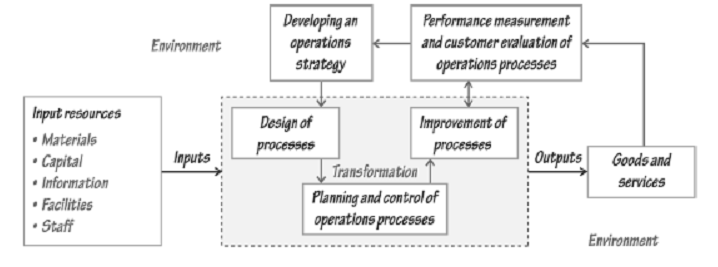
The operations function is concerned with the design of transformation processes, planning their use, and organising and controlling their day-to-day activities, ie how inputs can be acted upon to produce the required outputs, in the right quantities, of the right quality, at the right time. The operations function can control 70% of all assets. 

1. Operations can be viewed as a closed loop system. Systems display complex behaviour. 

2. Operations systems may be classified according to the extent to which products or services are made-to-order, assembled-to-order or made-for-stock. 

3. Operations systems may also be classified according to volume, variety or flexibility: project, job-shop, batch or continuous. 

4. Service operations may be usefully classified according to Schmenner's Matrix, according to their degrees of labour intensity and customisation/ customer interaction. 

5. As the service sector grows, it is increasingly apparent that service operations share many of the management problems encountered by production systems and can be described using the same theoretical constructs. 

6. Responsibilities of an operations manager and the interface with other functions such as marketing, people management and accounting and finance. 

7. The future challenges for operations managers especially in the service sector. 

8. Review of major stages in the evolution of operations: past, present and future. 

A general model of operations is illustrated in the following figure:
1533_Operations Function - Transformation Processes and Planning.png


Related Discussions:- Operations function - transformation processes and planning

Explain damage and restrict water access, Please explain how you would hand...

Please explain how you would handle the following question: An environmental impact statement confirms that you are within your legal rights to build a hotel property in a scenic a

Curtis and kastner stakeholder model, Curtis and Kastner Stakeholder Model ...

Curtis and Kastner Stakeholder Model Curtis and Kastner (1987) sought ways of adding value for each stakeholder group to ensure the long term success of the organisation. Int

Describe the growth in the service sector, Discuss the growth in the servic...

Discuss the growth in the service sector and the decline of manufacturing in the United States

Explain the fixed cost and the variable cost of production, The fixed cost ...

The fixed cost and the variable cost of production of product are 200000USD and demand is 500units to break even unit price of first 300 item will be?

Product redesign, factors that influence redesign process

factors that influence redesign process

Find probability distribution of single lot containing fault, A quality con...

A quality control unit in ball-bearing manufacturing company keeps record of error in terms of the number of faulty balls (W) per a lot. The size of standard lot is 8, and the prob

Stepping stone methods, Stepping Stone Methods : This is a procedure  ...

Stepping Stone Methods : This is a procedure  of determining the optimal if any for improving  each  of the non basic  variables  in terms of the objective function. To determ

Explain a difference between ethics and business ethics, Is there a differe...

Is there a difference between ethics and business ethics?

Write Your Message!

Captcha
Free Assignment Quote

Assured A++ Grade

Get guaranteed satisfaction & time on delivery in every assignment order you paid with us! We ensure premium quality solution document along with free turntin report!

All rights reserved! Copyrights ©2019-2020 ExpertsMind IT Educational Pvt Ltd