Implementation of queue, Data Structure & Algorithms

Assignment Help:

For a queue a physical analogy is a line at booking counter. At booking counter, customers go to the rear (end) of the line & customers are attended to several services from the front of the line. Unlike stack, customers are inserted at the rear end & deleted from the front end into a queue (FIFO).

In computer science, an instance of the queue is print jobs scheduled for printers. These jobs are maintained into a queue. The job fired for the printer first gets printed first. Similar is the scenario for job scheduling in the CPU of computer.

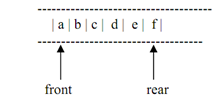
Like a stack, usually a queue also holds data elements of the similar type. Usually We graphically display a queue horizontally. Figure demonstrates a queue of 5 characters.
2141_IMPLEMENTATION OF QUEUE.png

        Figure: A queue of characters

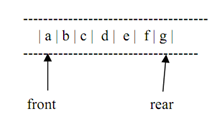
In a queue the rule followed is that elements are inserted at the rear & come off of the front of the queue. After the insertion of an element to the above queue, the position of rear pointer alters as illustrated below. Now the rear is pointing to the new element 'g' added at the rear of the queue.
1597_IMPLEMENTATION OF QUEUE1.png

Figure: Queue of above figure after addition of new element

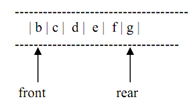
After the elimination of element 'a' from the front, the queue alters to the following along with the front pointer pointing to 'b'.
705_IMPLEMENTATION OF QUEUE2.png

Figure: Queue of figure 5.2 after deletion of an element

Algorithm for insertion of an element to the queue

Step 1: Create a new element to be inserted

Step 2: If the queue is empty, then go to

Step 3, else perform step 4

Step 3: Make the front & rear point this element

Step 4: Insert the element at the end of the queue and shift the rear pointer to the lately added element.

Algorithm for deletion of any element from the queue

Step 1: verify for Queue empty condition. If queue is empty, then go to step 2, else go to step 3

Step 2: Message "Queue Empty"

Step 3: Delete the element through the front of the queue. If in the queue it is the last element, then carry out step a else step b

a) make front & rear point to null

b) Shift the front pointer further on to point to the next element in the queue


Related Discussions:- Implementation of queue

What is solid modeling, What is Solid modeling Solid modeling is the mo...

What is Solid modeling Solid modeling is the most powerful of the 3-D modeling technique. It provides the user with complete information about the model. Defining an object wit

How conquer technique can be applied to binary trees, How divide and conque...

How divide and conquer technique can be applied to binary trees?  As the binary tree definition itself separates a binary tree into two smaller structures of the similar type,

Linked lists - implementation, The Linked list is a chain of structures whe...

The Linked list is a chain of structures wherein each structure contains data in addition to pointer, which stores the address (link) of the next logical structure in the list.

Prefix and Postfix Expressions, Q.   Draw the expression tree of the infix ...

Q.   Draw the expression tree of the infix expression written below and then  convert it intoPrefix and Postfix expressions. ((a + b) + c * (d + e) + f )* (g + h )

Heights of 500 students `Algorithms`, Write an algorithm, using a flowchart...

Write an algorithm, using a flowchart, which inputs the heights of all 500 students and outputs the height of the tallest person and the shortest p erson in the school.

Algorithm, Algorithm to find sum of square of a number

Algorithm to find sum of square of a number

STACK, 5. Implement a stack (write pseudo-code for STACK-EMPTY, PUSH, and P...

5. Implement a stack (write pseudo-code for STACK-EMPTY, PUSH, and POP) using a singly linked list L. The operations PUSH and POP should still take O(1) time.

Define the internal path length, Define the Internal Path Length The In...

Define the Internal Path Length The Internal Path Length I of an extended binary tree is explained as the sum of the lengths of the paths taken over all internal nodes- from th

Explain first - fit method, First - Fit Method: -    The free list is trave...

First - Fit Method: -    The free list is traversed sequentially to search the 1st free block whose size is larger than or equal to the amount requested. Once the block is found it

Sparse matrix, How sparse matrix stored in the memory of a computer?

How sparse matrix stored in the memory of a computer?

Write Your Message!

Captcha
Free Assignment Quote

Assured A++ Grade

Get guaranteed satisfaction & time on delivery in every assignment order you paid with us! We ensure premium quality solution document along with free turntin report!

All rights reserved! Copyrights ©2019-2020 ExpertsMind IT Educational Pvt Ltd