Explain mesh - current method, Electrical Engineering

Assignment Help:

Q. Explain Mesh - Current Method?

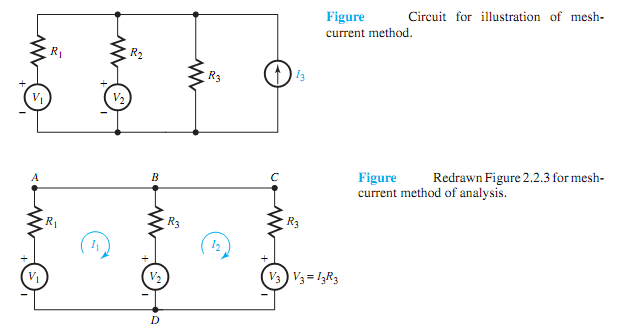
This complements the nodal-voltage method of circuit analysis. A set of independent mesh-current variables that implicitly satisfy the KCL equations is selected in order to formulate circuit equations in this mesh analysis. An elementary loop,ora mesh, is easily identified as one of the "window panes" of the whole circuit. However, it must be noted that not all circuits can be laid out to contain only meshes as in the case of planar networks. Those which cannot are called nonplanar circuits, for which the mesh analysis cannot be applied, but the nodal analysis can be employed.

A mesh current is a fictitious current, which is defined as the one circulating around a mesh of the circuit in a certain direction. While the direction is quite arbitrary, a clockwise direction is traditionally chosen. Branch currents can be found in terms of mesh currents, whose solution is obtained from the independent simultaneous equations. The number of necessary equations in the mesh-analysis method is equal to the number of independent loops or meshes.
812_Mesh - Current Method1.png

All current sourceswith shunt conductanceswill be replaced by their corresponding Thévenin equivalents consisting of voltage sources with series resistances. Let us illustrate the method by considering a simple, but typical, example, as shown in Figure (a).

Replacing the current sourcewith shunt resistance by the Thévenin equivalent, Figure (a) is redrawn as Figure (b), in which one can identify two elementary loops, or independent meshes.

By assigning loop or mesh-current variables I1 and I2, as shown in Figure (b) , both in the clockwise direction, one can write the KVL equations for the two closed paths (loops) ABDA and BCDB,

1575_Mesh - Current Method.png


Related Discussions:- Explain mesh - current method

Object oriented programming by robert lafore 4th edition sol, Ask quobject ...

Ask quobject oriented programming by robert lafore 4th edition solutionestion #Minimum 100 words accepted#

The resistance of an 8 m length of the same wire, The resistance of a 5 m l...

The resistance of a 5 m length of wire is 600Ω.Determine: a)  the resistance of an 8 m length of the same wire, b)  the length of the same wire when the resistance is 420Ω

Self inductance , Self Inductance If a current is passed through a co...

Self Inductance If a current is passed through a coil, it creates a flux within the coil. Any attempt to change this flux will create a back emf that acts to oppose the chang

Single phase half wave controlled rectifier , Single Phase Half wave contro...

Single Phase Half wave controlled Rectifier In half  wave  rectification either  the positive or negative half  of the ac wave is  passed while  the other  half is blocked. Be

Equalizer rings, purpose of equalizer rings in lap winding

purpose of equalizer rings in lap winding

Phase shifter, Hi, I just finish writing my project literature review and ...

Hi, I just finish writing my project literature review and my supervisory asked me to add one part. This part is about Phase Shift. How phase shifters work? In Particular How the

Give a few applications of superconductors, Give a few applications of supe...

Give a few applications of superconductors. Also give three applications of superconductors. Application of superconductors in Electrical and Electronic Engineering (i) The

Crt and cro, working principle of crtand block diagram of cro

working principle of crtand block diagram of cro

Determine lower and upper cut-off frequency, Q. In an amplifier, the maximu...

Q. In an amplifier, the maximum voltage gain is 1500 and occurs at 1kHz. It falls to 1060.5 at 20kHz and at 20Hz. Determine (i) lower cut-off frequency (ii) upper cut-o

Write Your Message!

Captcha
Free Assignment Quote

Assured A++ Grade

Get guaranteed satisfaction & time on delivery in every assignment order you paid with us! We ensure premium quality solution document along with free turntin report!

All rights reserved! Copyrights ©2019-2020 ExpertsMind IT Educational Pvt Ltd