Example of introducing the government- accounting system, Macroeconomics

Assignment Help:


Example of Introducing the Government- ACCOUNTING SYSTEM 

So far there was no government in any of our stylized economies. Let us now introduce it. To begin with, our government engages in the following activities:

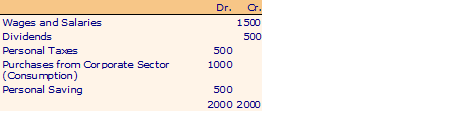
a. Imposes and collects taxes on personal income and corporate profits.

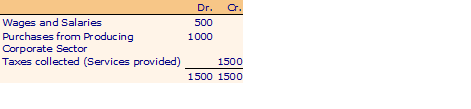
b. Employs labor, purchases goods and services from the corporate sector and using them as inputs 'produces' government services which are made available to the public without any explicit charges. 

We set up the sector accounts as follows: 

  Production Sector                                      
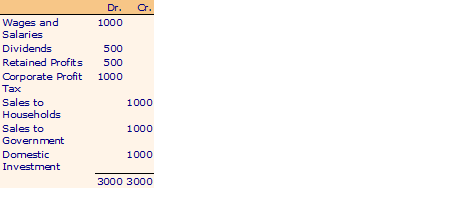
                                 2351_Production Account13.png


 Government 

                                289_Production Account13.png

 Household Sector 

 1970_Production Account13.png

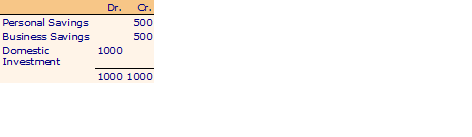
Savings and Investment                              

                                1158_Production Account13.png


a. Total Value of Final Goods and Services:

1000 (Consumption) + 1000 (Investment) + 1500 (Government Services) = 3500

Here we treat government like any other producer whose output (government services) is bought by the 'public' by paying for it through taxes. All government services are treated as 'final output'.

b. Total Value Added:

1500 (Wages and Salaries) + (Gross Profits) 2000 = 3500

Once again government is treated as a producer which buys 'raw materials' and with the help of hired labor adds value to it.

c. c. Consumption + Investment + Government Expenditure:

1000 + 1000 + 1500 = 3500

Here we separate all governmental expenditures and add these to non-government expenditure on final output.

Conceptually, there is no difficulty in treating government like any other producer. However, a large part of government output is not sold through markets. Further, the government does not make its production decisions in response to market incentives like profitability. It cannot always identify which part of the tax revenue is financing which of its activities. Taxes people pay may not bear any relation with the amount of government services they consume. For all these reasons government expenditures are treated as a separate component of GNP as in (3) above. Government is treated in a dual role - producer of services and also as a collective 'consumer' on behalf of the society. 

How about government enterprises like HMT, Modern Foods, etc.? They can be treated on par with non-government productive establishments since their output is sold in well-defined markets. (C + I) then includes output of consumption and investment goods by public and private sector enterprises. GNI includes factor incomes earned in these enterprises including any surpluses.

Thus for this example

GNP = C + I + G

where G denotes government expenditure. 


Related Discussions:- Example of introducing the government- accounting system

Microsoft stock buy call options, Suppose you buy call options on Microsoft...

Suppose you buy call options on Microsoft stock. Each option costs $2 and has the strike price of $40 and the expiration date July 1. Discuss whether you would exercise the options

Result of an export subsidy, Which of the following is a result of an expor...

Which of the following is a result of an export subsidy? a. The imposing nation always benefits from an export subsidy. b. The imposing nation suffers a terms of trade loss from an

IS LM MODEL, Using the equilibrium in the labor market and the model IS-LM ...

Using the equilibrium in the labor market and the model IS-LM explain the different behavior described by the classic and keynessian schools when there is an increase in public spe

Marginal propensity to consume economy, Consider the following: An econo...

Consider the following: An economy is found to have output, y = 20000 Also assume that the government runs a deficit where tax revenue T= 4000 and government expenditures G=5000

Rapidly rises housing prices, Why did housing prices rise rapidly during 20...

Why did housing prices rise rapidly during 2002-2005? Why did the mortgage default rate increase so sharply during 2006 and 2007 even before the 2008-2009 recession began?

The transmission mechanism - monetary policy, The Transmission Mechanism ...

The Transmission Mechanism The mechanism by which the changes in monetary policy affect aggregate demand is called 'transmission mechanism'. Two stages in transmission mechanis

Law of diminishing returns, Explain the law of diminishing marginal returns...

Explain the law of diminishing marginal returns using the example of a factory which is currently running at half capacity and employs more staff

At some number payment is fixed, The United States Treasury borrows money ...

The United States Treasury borrows money on behalf of the federal government all the time. One type of the government borrowing, called a treasury bills, promises a fixed payment a

Factors responsible for changes in aggregate demand, Factors Responsible fo...

Factors Responsible for changes in Aggregate Demand The Aggregate Demand curve shows an inverse relationship between the quantity of goods and services demanded and the price l

BANK, HOW CAN CENTRAL BANK INFLUENCE THE STABILITY OF THE BANKING SYSTEM?

HOW CAN CENTRAL BANK INFLUENCE THE STABILITY OF THE BANKING SYSTEM?

Write Your Message!

Captcha
Free Assignment Quote

Assured A++ Grade

Get guaranteed satisfaction & time on delivery in every assignment order you paid with us! We ensure premium quality solution document along with free turntin report!

All rights reserved! Copyrights ©2019-2020 ExpertsMind IT Educational Pvt Ltd