Draw the circuit of A/D converter using a V/F converter, Computer Engineering

Assignment Help:

Draw the schematic circuit of an Analog to Digital converter using Voltage-to Frequency conversion and explain its principle of operation. Draw its relevant Waveforms.

Ans:

Analog to Digital Converter Using Voltage-to-Frequency Conversion: An analog voltage can be converted into digital form by producing pulses whose frequency is proportional to the analog voltage. These pulses are counted by a counter for a fixed duration and the reading of the counter will be proportional to the frequency of the pulses and hence to the analog voltage.

A voltage-to-frequency converter is shown in Fig. (a). The analog voltage Va is applied to an integrator whose output is applied at the inverting input terminal of a comparator. The non-inverting input terminal of the comparator is connected to a reference voltage -VR.

Initially, the switch S is open and the voltage vo decreases linearly with time (vo = Vat/τ ) which is shown in Fig. 10(b). When the decreasing vo reaches -VR at t =T, the comparator output  VC   goes  HIGH.  This  is  used  to  close  the  switch  S  through  a  monostable multivibrator. When the switch S is closed, the capacitor C discharges, thereby returning the integrator output vo  to 0. Since the pulse width of the waveform VC is very small, therefore, a monostable multivibrator is used to keep the switch S closed for a sufficient time to discharge the capacitor completely. The rate at which the capacitor discharges depends upon the resistance of the switch.

Let the pulse width of the monostable multivibrator be Td. Therefore, the switch S remains closed for Td after which it opens and vo starts decreasing again.

If the integration time T >> Td, the frequency of the waveforms Vo and VC is given by

 f = 1/( T + Td)  ≅  1/T = (1/ τ) (Va/VR)

Therefore we get an output waveform whose frequency is proportional to the analog input voltage. Using the voltage-to-frequency (V/F) converter an A/D converter is demonstrated in Fig.(c). The output of the voltage-to-frequency converter is applied at the clock (CK) input of a counter throughout an AND gate. For a fixed time interval T1, the AND gate is enabled. The reading of the counter at t = T1 is specified by

n =  fT1 =  (1/ τ) (Va/VR) T1  that is proportional to Va
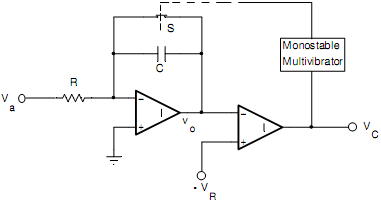
558_Logic diagram of Voltage-to-Frequency Converter.png

Fig.(a) Logic diagram of Voltage-to-Frequency Converter
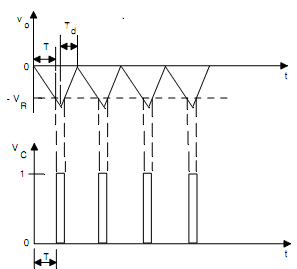


1904_Waveforms of Voltage-to-Frequency Converter.png

Fig.(b) Waveforms of Voltage-to-Frequency Converter
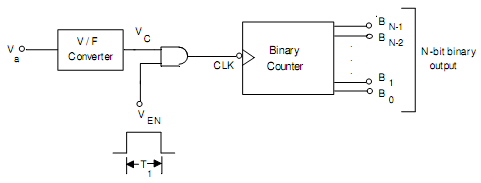


131_Schematic circuit of AD converter using a VF converter.png

Fig.(c) Schematic circuit of A/D converter using a V/F converter


Related Discussions:- Draw the circuit of A/D converter using a V/F converter

Poor technology or system requirements definition, Poor Technology or Syste...

Poor Technology or System Requirements Definition - Information System Previously we looked at product design and specifically the importance of requirements capture as part o

Explain in detail about the random scan display, Explain in detail about th...

Explain in detail about the Random Scan Display   This device using CRT directs the electron beam only to the parts of the screen where a picture is to be drawn. This kind of d

What is clipboard, Clipboard is a temporary storage location in Windows. Th...

Clipboard is a temporary storage location in Windows. The clipart will kept one piece of information at a time when it is manually added to the clipart or is copied there.

What is an adaptor class or wrapper class in c++, A class that has no funct...

A class that has no functionality of its own is an Adaptor class in C++. Its member functions hide the use of a third party software component or an object with the non-compatible

Define the node of object oriented modeling, Define the node of object orie...

Define the node of object oriented modeling A node is a physical element which exists at runtime and represents a computational resource usually having a large memory and often

Explain what is dtmf signalling, Explain what is DTMF signalling. Dual ...

Explain what is DTMF signalling. Dual Tone Multi Frequency (DTMF) was initially introduced in 1963 with 10 buttons into Western Electric 1500 -type telephones. Dual Tone Multi

Determine the equivalent in octal of decimal number, Convert decimal 153 to...

Convert decimal 153 to octal. Equivalent in octal will be ? Ans. (153) 10 = (231) 8

What are the limitations of traditional payment instruments, What are the l...

What are the limitations of traditional payment instruments? The limitations of traditional payment system are that they take a lot of time.  These systems needs manual work to

Don''t care states, The conflict between too hot and too cold or too slow a...

The conflict between too hot and too cold or too slow and too fast can be resolved using don't care states. Don't care states are used when i) the state of the output is not

What is bea weblogic?, Ans) BEA Web Logic is a J2EE application server and ...

Ans) BEA Web Logic is a J2EE application server and also an HTTP web server by BEA Systems of San Jose, California, for UNIX, Linux, Microsoft Windows, and other platforms. Web Log

Write Your Message!

Captcha
Free Assignment Quote

Assured A++ Grade

Get guaranteed satisfaction & time on delivery in every assignment order you paid with us! We ensure premium quality solution document along with free turntin report!

All rights reserved! Copyrights ©2019-2020 ExpertsMind IT Educational Pvt Ltd