Cohen sutherland line clippings algorithm, Computer Graphics

Assignment Help:

Cohen Sutherland Line Clippings Algorithm

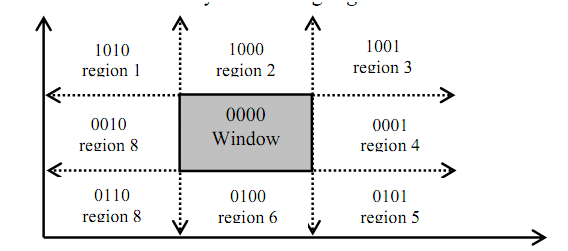
The clipping problem is identified by dividing the region surrounding the window area into four segments Up as U, Down as D, Left as L, Right as R and assignment of number 1 and 0 to respective segments assists in positioning the area surrounding the window. How this positioning of areas is performed can be well determined by understood in following figure.
2465_Cohen Sutherland Line Clippings Algorithm.png

Figure: Positioning of regions surrounding the window

In figure as given above we have noticed that each coding of areas U, D, L and R is done along w.i.t. window region. Since window is neither Left nor Right, neither up nor down so, the respective bits UDLR are 0000; currently see area1 of above figure. The positioning code UDLR is 1010, that is the area1 lying on the position that is upper left side of the window. Hence, area1 has UDLR code 1010 i.e. Up so U=1, not Down so D=0, Left so L=1, not Right so R=0.

The sense of the UDLR code to identify the location of region w.i.t. window is:

1st bit ⇒ Up(U) ; 2nd bit ⇒ Down(D) ;3rd bit ⇒ Left(L) ;  4th bit ⇒ Right(R),

Currently, to perform Line clipping for different line segment that may reside within the window region partially or fully, or may not even lie in the widow area; we utilize the tool of logical ANDing among the UDLR codes of the points lying on the line.

Logical ANDing (^) operation

=>

1 ^ 1 = 1; 1 ^ 0 = 0;

between respective bits implies


Note:


0 ^ 1 = 0; 0 ^ 0 = 0


  • UDLR code of window is 0000 all the time and with respect to this will generate bit codes of other areas.
  • A line segment is observable if both the UDLR codes of the end points of the line segment equal to 0000 that is UDLR code of window area. If the resulting code is not 0000 then, which line segment or section of line segment may or may not be observable

Related Discussions:- Cohen sutherland line clippings algorithm

Transformation for isometric projection - transformation, Transformation fo...

Transformation for Isometric projection - Transformation Suppose that P(x,y,z) be any point in a space.  Assume as a given point P(x,y,z) is projected to the P'(x'y',z') on t

Gif file compression, GIF File Compression The Graphic Interchange Form...

GIF File Compression The Graphic Interchange Format file format utilizes a relatively basic form of file compression which squeezes out inefficiencies within the data storage w

Vecgen, explain vecgen algoritham

explain vecgen algoritham

Z-buffer, describe z-buffer algorithm removing hidden surface

describe z-buffer algorithm removing hidden surface

Explain vector data model with examples, Question 1 How does GIS differ fr...

Question 1 How does GIS differ from traditional Maps? Explain Question 2 Explain vector data model with examples Question 3 What is spatial analysis? explain

Applications for computer animation-physics, Normal 0 false f...

Normal 0 false false false EN-US X-NONE X-NONE

Characteristics of bitmap data, Characteristics of Bitmap Data: Bitmap dat...

Characteristics of Bitmap Data: Bitmap data can take up many rooms. A CMYK A-4 size picture which is optimized for medium quality printing (150 lpi) takes up 40 Mage Bytes. Compre

Common principles of ray tracing, Common Principles of Ray Tracing Bas...

Common Principles of Ray Tracing Based upon the nature or attributes of the surface given by the user, the subsequent effects are implemented, as per to rules of optics:  a

Write Your Message!

Captcha
Free Assignment Quote

Assured A++ Grade

Get guaranteed satisfaction & time on delivery in every assignment order you paid with us! We ensure premium quality solution document along with free turntin report!

All rights reserved! Copyrights ©2019-2020 ExpertsMind IT Educational Pvt Ltd