Calculate the theoretical mean value for signal, Electrical Engineering

Assignment Help:

In most real signal processing applications the measured signals can not be described by an analytical expression. In addition, by the Wold decomposition theorem a stationary signal can be represented as a sum of its predictable part and its stochastic part. Here, we focus on stochastic signals. Real signals are generally random (stochastic) in nature and therefore, it is only possible to de?ne their statistical properties. A simple discrete random signal may be generated from within MATLAB with the rand function (generates a zero-mean white Gaussian noise signal).

a) Generate a length 1000 discrete random signal x, a bold font is used to emphasise that it is a random signal, and display the result with the stem function.

Observe that although this signal can clearly not be represented by an analytical expression, there is a degree of uniformity along its length, i.e. thestatistical properties of the signal are not time-varying. Such a signal is said to be statistically stationary.

- Use the MATLAB documentation to discover more about the rand function and how it generates random numbers.

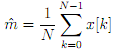
- Calculate the theoretical mean value for this signal; this quantity can be estimated from x with
2348_Calculate the theoretical mean value for this signal.png

where m' is the so-called sample mean, the circum?ex denotes that the quantity is an estimate.

- Use the mean function within MATLAB to perform this calculation for x. How accurate is this estimate?

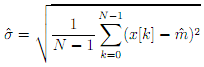
- Calculate the standard deviation for this signal; estimate this quantity with the std function which is based upon and
401_Calculate the theoretical mean value for this signal1.png

is referred to as the standard deviation.

- Use the rand function to generate, in turn, nine more length 1000 random signals and calculate sample mean and standard deviations
for each signal. Plot the sample mean and standard deviations values for the ten signals and show they cluster about the true values.

What can you say about the bias of these estimators?

The mean and standard deviation are two quantities which describe the statistical properties of a statistically stationary random signal.
To obtain a complete statistical description of the signal it is necessary to examine the probability density function from which each time
sample is drawn.

- Use the hist function to approximate the probability density function for one of the length 1000 x signals (The true probability density function would be obtained if the output from hist was scaled by the number of points in x). Comment upon the result, in particular, what function will it converge to as the length of x becomes very large?


Related Discussions:- Calculate the theoretical mean value for signal

Determine the current by mesh analysis, Q. Determine the current I through ...

Q. Determine the current I through the 10- resistor of the circuit of Figure by employing the node-voltage method. Check by mesh analysis.

Determine the equivalent inductance, Determine the equivalent inductance: ...

Determine the equivalent inductance: Two coils of inductances 4H and 6H are connected in parallel. If their mutual inductance is 3 H, determine the equivalent inductance of th

Ac generators - the alternator, In practice, it is usually better to wind t...

In practice, it is usually better to wind the field coils on the rotor and supply the field current to them via slip rings.  As the rotor turns, the changing magnetic field expe

Multiplexed address data bus - pins and signals , Multiplexed Address/ Data...

Multiplexed Address/ Data Bus Pins AD 7 - AD) are used for multiplexed address data bus. This bus is bidirectional  input output  and  serves two  purpose. Initially the bus

Compare procedure and macro, Compare Procedure & Macro  Accessed by CAL...

Compare Procedure & Macro  Accessed by CALL & RET instruction Accessed during assembly with name given during program implementation to macro when defined Machine code for inst

Define lines parameters, Define Lines Parameters In power system analys...

Define Lines Parameters In power system analysis, the parameters of interest when modelling power lines are:  inductance, capacitance, series resistance and leakage resistance.

Two-level system - princeton, Conceive a system composed of a very large nu...

Conceive a system composed of a very large number N of distinguishable atoms at rest and mutually noninteracting, each of which has only two (nondegenerate) energy levels:0,ε>0 Let

Explain time-invariant versus time-varying systems, Q. Explain Time-invaria...

Q. Explain Time-invariant versus time-varying systems? When the parameters of a control systemare stationary with respect to time during the operation of the system, the system

Show applications for synchronous motors, Q. Show Applications for Synchron...

Q. Show Applications for Synchronous Motors? With constant-speed operation, power factor control, and high operating efficiency, three-phase synchronous motors are employed in

What do you mean by instrument transformers, Q. What do you mean by Instrum...

Q. What do you mean by Instrument transformers? These are generally of two types, potential transformers (PTs) and current transformers (CTs). They are designed in such a way t

Write Your Message!

Captcha
Free Assignment Quote

Assured A++ Grade

Get guaranteed satisfaction & time on delivery in every assignment order you paid with us! We ensure premium quality solution document along with free turntin report!

All rights reserved! Copyrights ©2019-2020 ExpertsMind IT Educational Pvt Ltd