Aerodynamics-boundary layers, Other Engineering

Assignment Help:

Approach

The Hanley solver does solve for the boundary layer and potential flow (in a way we will think about later). However, it only gives us full access to the potential solution, with limited information on the boundary layer. To give us more information we will use two programs (in the form of applets accessed from the internet). These applets are solving the boundary layer equations (which

represents a branch on your model chart). We will not go into the details of these equations, but look into Anderson and find what assumptions these equations are based on, and add these to your model chart.


Select the applets "Boundary Layer Applets + Convection" and wait for the panel to be filled with 8 buttons.  Be patient - it takes a few seconds for the applets to respond. Some of these applets are solving the boundary layer equations (which represents a branch on your model chart). We will not go into the details of these equations, but after your tutorial look into Anderson and find what

assumptions these equations are based on, and add these to your model chart.


Preparation: Brief Introduction to Boundary Layers


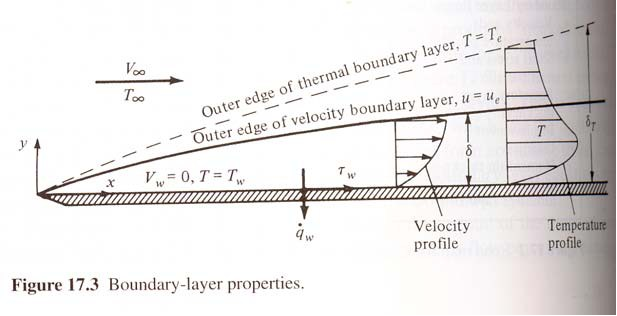
Friction is important in a thin region, called the boundary layer, adjacent to the aerofoil surface. This region is called the boundary layer. Outside this region the flow is irrotational, and for low speed flow can be approximated very well by a potential model. The pressure felt at the wall is usually the same as that felt at the edge of the boundary layer. (Note that this makes the potential solver very useful for computing the lift of an aerofoil).


A schematic of the boundary layer taken from Anderson is shown in the figure below. Think about the flow structure shown. Chapters 15 and 17 of Anderson are useful resources for the boundary layer topic.
 

1214_boundary layers.png


Related Discussions:- Aerodynamics-boundary layers

Thrust calculation- aeronautical engineering , Thrust calculation: The ...

Thrust calculation: The amount of thrust produced depends upon two things:- The MASS of air which is moved rearwards in a given time, the ACCELERATION imparted to the air.It

Calculate the thermal conductivity, A steak which is 2.5cm thick is cooking...

A steak which is 2.5cm thick is cooking in a frying pan which has a 4mm thick base. The electric element used to heat the pan is turned to a level such that the bottom surface of t

Car parking control system programming, I have to develop a program for car...

I have to develop a program for car parking control system program on assembly language using AT89C51,please help me with it

Structural engineering, The closed form solutions for ?max and Mmax are giv...

The closed form solutions for ?max and Mmax are given on page 16.1-276 for several axial loads. Figure C-C2.2 summarizes the results for the first benchmark problem and Figure C-C2

Tunnel diode, equivalent circuit of tunnel diode

equivalent circuit of tunnel diode

Casting alloys, Casting Alloys are -             (i) Permanent moulds...

Casting Alloys are -             (i) Permanent moulds are commonly used for the casting of grey iron, aluminum alloys and magnesium alloys.             (ii) Slush Casting

Write Your Message!

Captcha
Free Assignment Quote

Assured A++ Grade

Get guaranteed satisfaction & time on delivery in every assignment order you paid with us! We ensure premium quality solution document along with free turntin report!

All rights reserved! Copyrights ©2019-2020 ExpertsMind IT Educational Pvt Ltd