8255 programmable peripheral interface-microprocessor, Assembly Language

Assignment Help:

8255 Programmable Peripheral Interface

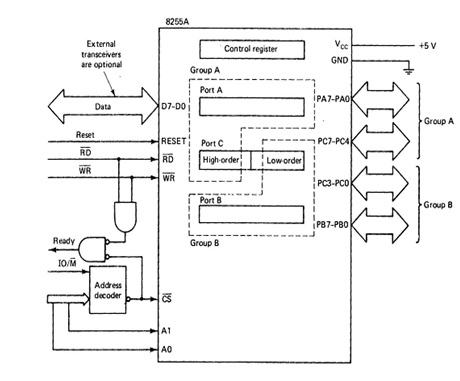
Intel's 8255 A programmable peripheral interface provides a nice instance of a parallel  interface. As shown the interface have a control register and 3 separately addressable ports, denoted from A, B, and C. Whether or not an 8255A is being accessed is determined by the signal on the CS pin and the direction of the access is according to the WR and RD signals. Which of the 4 registers is being addressed is determined by the signals applied to the pins A0 and A1. So, the lowest port address assigned to an 8255 A might be divisible by 4. A review of the 8255 A's addressing is:

A1        A0        RD       WR      CS        Transfer Description

0          0          0          1          0          Port A to data bus

0          1          0          1          0          Port B to data bus

1          0          0          1          0          Port C to data bus

0          0          1          0          0          Data bus to port A

0          1          1          0          0          Data bus to port B

1          0          1          0          0          Data bus to port C

1          1          1          0          0          Data bus to control register if D7= 1; if D7=0 input from the data bus is treated as a Set/Reset instruction

x          x          x          x          1          D7-D0 go to high-impedance state

1          1          0          1          0          Illegal combination

x          x          1          1          0          D7-D0 go to high-impedance state

Where 0 is low and 1 is high

Because the bits in port C are sometimes utilized as control bits, the 8255 A is designed so that they may be output to separately by using a Reset/set instruction. When the 8255 A receives a byte that is directed to its control register, it checked data bit 7.If this bit is one, the data are transferred to the control register, but if it is zero, the data retreated as a Reset/set instruction and is utilized to clear or set the port C it denoted by the instruction. Bits 3-1 gives the bit number of the bit to be changed and bit 0 denote whether it is to be cleared or set. The remaining bits are not useful.
535_8255.jpg

The bits in the 3 ports are attached to pins that can be linked to the I/O device. These bits are divided into groups A & B, with group A consisting of the bits in port A and the 4 MSBs of port C and group b consisting of port B and the 4 LSBs of port C. the use of each of the 2 groups is controlled by the mode connected with it. Group A is connected with 1 of 3 modes, mode zero, mode one, and mode two, and group B with 1 of 2 modes, mode 0 and mode 1.


Related Discussions:- 8255 programmable peripheral interface-microprocessor

Signal descriptions of 8086-microprocessor, Signal descriptions of 8086 : ...

Signal descriptions of 8086 : described below are common for the maximum andminimum mode bothdata lines AD15 -AD0: These are the time multiplexed andmemory I/O address. Addre

Define word (dw)- assemblers directive-microprocessor, DW : Define Word:- ...

DW : Define Word:- The DW directive serves the same purposes as the DB directive, but now it makes the assembler  which reserves thenumber ofmemory words (16-bit) instead of by

Develop a schematic circuit diagram of system, Develop a suitable schematic...

Develop a suitable schematic circuit diagram of your system showing the interface between the PIC16F84 and the existing mains light & switch, including 5V derivation from the 240V

Explore debugger, add the contents of the defined memory locations 120, 133...

add the contents of the defined memory locations 120, 133, 122 using mov instruction in dosbox

Relocate program and data, ) What is the difference between re-locatable pr...

) What is the difference between re-locatable program and re-locatable data?

Assembly language, how to find out the given number is positive or negative...

how to find out the given number is positive or negative?

Segment registers-microprocessor, Segment Registers The 8086 addresses ...

Segment Registers The 8086 addresses a segmented memory unlike 8085. The complete 1 megabyte memory, which 8086 is capable to address is divided into 16 logical segments.Thusea

Into-jmp-unconditional branch instruction-microprocessor, INTO : Interrupt...

INTO : Interrupt on Overflow:- It is executed, when the overflow flag OF is set. The new contents of IP and CS register are taken from the address 0000:0000 as described in INT

Pointer(ptr)-assemblers directive-microprocessor, PTR : Pointer:- The p...

PTR : Pointer:- The pointer operator which is used to declare the type of a variable, label or memory operand. The operator PTR is prefixed by either WORD or BYTE. If the prefi

Cbw-cwd-arithmetic instruction-microprocessor, CBW: Convert Signed Byte to...

CBW: Convert Signed Byte to Word: This instruction converts a signed byte to a signed word. In other terms, it copies the sign bit of a byte to be converted to all of the bits in

Write Your Message!

Captcha
Free Assignment Quote

Assured A++ Grade

Get guaranteed satisfaction & time on delivery in every assignment order you paid with us! We ensure premium quality solution document along with free turntin report!

All rights reserved! Copyrights ©2019-2020 ExpertsMind IT Educational Pvt Ltd