Write down the first few terms of the sequences, Mathematics

Assignment Help:

Write down the first few terms of each of the subsequent sequences.

1. {n+1 / n2} n=1

2. {(-1)n+1 / 2n} n=0

3. {bn} n=1, where bn = nth digit of ?

Solution

1. {n+1 / n2} n=1

To obtain the first few sequence terms here all we require to do is plug in values of n into the formula given and we'll obtain the sequence terms.
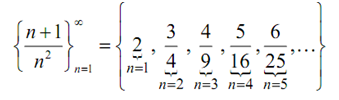
2041_Write down the first few terms of the Sequences.png

Note: Inclusion of the "..." at the end! This is a significant piece of notation as it is the just only thing that tells us that the sequence carries on and doesn't end at the last term.

(2) {(-1)n+1 / 2n} n=0

This one is identical to the first one. The main variation is that this sequence doesn't initiate at n = 1.

{(-1) n+1 / 2n} n=0 = {=1, ½ , - ¼ , 1/8, - 1/16, ....}

Note: The terms used in this sequence alternate in signs. Sequences of this type are sometimes known as alternating sequences.

(3) {bn} n=1, where bn = nth digit of ?

This sequence is not same from the first two in the sense that it doesn't have a particular formula for each term.  Though, it does tell us what every term should be. Every term should be the nth digit of ?. So we know that ? = 3.14159265359....

After that the sequence is,

{3,1, 4,1, 5, 9, 2, 6, 5, 3, 5,...}


Related Discussions:- Write down the first few terms of the sequences

Applications of derivatives rate change, Application of rate change Bri...

Application of rate change Brief set of examples concentrating on the rate of change application of derivatives is given in this section.  Example    Find out all the point

Trigonometric ratios, to difine trigonometric ratios of an angle,is it nece...

to difine trigonometric ratios of an angle,is it necessary that the initial ray of the angle must be positive x-axis?

Compute the probability of event, 1) Let the Sample Space S = {1, 2, 3, 4, ...

1) Let the Sample Space S = {1, 2, 3, 4, 5, 6, 7, 8}. Suppose each outcome is equally likely. Compute the probability of event E = "an even number is selected". P(E) = 2) A s

Show inverse trigonometric functions, Q. Show Inverse Trigonometric Functio...

Q. Show Inverse Trigonometric Functions? Ans. Many functions, including trig functions, are invertible. The inverse of trig functions are called ‘inverse trig functions'.

Course work2 , (b) The arity of an operator in propositional logic is the n...

(b) The arity of an operator in propositional logic is the number of propositional variables that it acts on – for example, binary operations (e.g, AND, OR, XOR…) act on two propo

Exponent, base also called what

base also called what

Linear equation in two variables., draw the graph of following pair of line...

draw the graph of following pair of linear equation:-2y=4x-6

Mathematics Warm-Ups for CCSS, Ask question #Minimum 100 words accepted wha...

Ask question #Minimum 100 words accepted what is a ratio

Negative three and positive eight inclusive represent y, The value of y is ...

The value of y is among negative three and positive eight inclusive. Which of the subsequent represents y? This inequality displays a solution set where y is greater than or eq

Solving an equation problems, Temperature: On one day in Fairfield, Montana...

Temperature: On one day in Fairfield, Montana the temperature dropped 80 degree fahrenheit from noon to midnight. If the temperature at midnight was -21 degree fahrenheit, write an

Write Your Message!

Captcha
Free Assignment Quote

Assured A++ Grade

Get guaranteed satisfaction & time on delivery in every assignment order you paid with us! We ensure premium quality solution document along with free turntin report!

All rights reserved! Copyrights ©2019-2020 ExpertsMind IT Educational Pvt Ltd