What is polyphase induction machine performance, Electrical Engineering

Assignment Help:

Q. What is Polyphase Induction Machine Performance?

Some of the important steady-state performance characteristics of a polyphase induction motor include the variation of current, speed, and losses as the load-torque requirements change, and the starting and maximum torque. Performance calculations can be made from the equivalent circuit. All calculations can be made on a per-phase basis, assuming balanced operation of the machine. Total quantities can be obtained by using an appropriate multiplying factor.

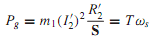
The equivalent circuit of Figure (c), redrawn for convenience in Figure, is usually employed for the analysis. The core losses, most of which occur in the stator, as well as friction, windage, and stray-load losses, are included in the efficiency calculations. The power- flow diagram for an induction motor is given in Figure, in which m1 is the number of stator phases, φ1 is the power factor angle between ¯V1 and ¯I1, φ2 is the power factor angle between ¯E1 and ¯I2, T is the internal electromagnetic torque developed, ωs is the synchronous angular velocity inmechanical radians per second, and ωm is the actualmechanical rotor speed given by ωs (1-S). The total power Pg transferred across the air gap from the stator is the difference between the electric power input Pi and the stator copper loss. Pg is thus the total rotor input power, which is dissipated in the resistance R2'/S of each phase so that

1094_What is Polyphase Induction Machine Performance.png

Subtracting the total rotor copper loss, which is m1(I'2)2 R'2 or SP8, from Equation for Pg, we get the internal mechanical power developed,


Related Discussions:- What is polyphase induction machine performance

What is thermal runaway, Q. What is thermal runaway. The problem of sel...

Q. What is thermal runaway. The problem of self heating arises due to dissipation of power at the collector junction. The leakage current ICBO is extremely temperature dependen

D flip-flop - latch or delay element, Q. D flip-flop - latch or delay eleme...

Q. D flip-flop - latch or delay element? The symbol for the clocked D flip-flop is shown in Figure (a), in which the two output terminals Q and ¯ Q behave just as in the SRFF,

Transmission and swiching systems, using a combination of uniselectors and ...

using a combination of uniselectors and two motion selectors, draw a schematic of thousand line exchange and explain its working

Derive the solution of the characteristic equation, For a vehicle suspensio...

For a vehicle suspension, a basic two-degree-of-freedom "quarter-car" model would be slightly more complicated than the spring-mass-damper system I chose to study in Figure 1. The

Impedance / DUTT, 3) The impedance for a 120 km, 230-kV line is given as j ...

3) The impedance for a 120 km, 230-kV line is given as j 0.9 ohm/km and j 0.6 ohm/km for self and mutual terms respectively; resistance is neglected. The mho characteristic for the

Explain various functions of telephone switching systems, Q. Explain variou...

Q. Explain various functions of telephone switching systems. Ans: Functions of telephone switching systems are: (i)  Attending: The system should be continually monito

DLD, draw alogic diagramto implement F=ABCDE using only 3 inputAND gates

draw alogic diagramto implement F=ABCDE using only 3 inputAND gates

Advanced mobile phone system, Q. Advanced Mobile Phone System? Cellular...

Q. Advanced Mobile Phone System? Cellular systems employed cells with a radius in the range of 5-18 km. The base station usually transmitted at a power level of 35 W or less, a

Write Your Message!

Captcha
Free Assignment Quote

Assured A++ Grade

Get guaranteed satisfaction & time on delivery in every assignment order you paid with us! We ensure premium quality solution document along with free turntin report!

All rights reserved! Copyrights ©2019-2020 ExpertsMind IT Educational Pvt Ltd