What is gas laws, Physics

Assignment Help:

What is Gas Laws?

Kinetic theory states that the speed of motion of the molecules in a substance decreases as the substance's temperature decreases. As well, the speed of motion of the molecules in a substance rises like the substance's temperature increases. If the pressure on a gas is maintain constant, adding heat to the gas will reason it to expand, or raise its volume. It was experiential that, for a given temperature change, all gases expanded by similar amount of volume. This leads to Charles' Law for gases:

V1/V2 = T1 (K) /T2 (K)

In which pressure must be constant, and as we are dealing with ratios, the volume units utilized do not matter as much as long as they match. Although, temperature should be in kelvins for this equation to work!

Kelvin extrapolated this property of gases to point out a temperature in which if the gas stayed a gas, (clearly real gases don't do this, they become liquids first) the molecules or atoms of the gas would comprise zero internal kinetic energy. Kelvin took this to be absolute zero on the temperature scale that today bears his name.

Other gas law is Boyle's Law. If the temperature is held constant, the volume of the gas changes inversely along with its pressure.

 P1 V1 = P2 V2                                          

where temperature must be held constant and pressure and volume units just need to match. These two laws can be combined to state the general gas law:          

P1 V1/ T1 (K) = P2 V2/ T2 (K)                                     

where pressure units need to match, volume units must match, and temperature must be used in kelvins.

Example - The volume of a given mass of gas will be doubled if the pressure is held constant and the temperature of the gas is increased from 120oC to what final temperature?
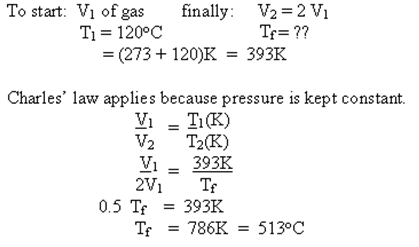
2204_Gas Laws.png


Related Discussions:- What is gas laws

SI unit, what is the importance of si unit

what is the importance of si unit

Calculate the refractive index of liquid, Focal length of convex lens is 0....

Focal length of convex lens is 0.1 m. A liquid lens is formed between a plane surface and one face of this lens of radius of curvature 0.12m. The converging combination formed is f

Aget an expression for lateral shift, Get an expression for lateral shift p...

Get an expression for lateral shift produced by a parallel sided glass slab placed in air.

Determine the moment of inertia, Determine the moment of inertia with respe...

Determine the moment of inertia with respect to the x axis for the shaded area shown (Figure 2) . The dimension is a = 2.00m

Portray is a principal ray for the case of a concave lens, Question: Po...

Question: Portray is a principal ray for the case of a concave lens. Where does it depart from here? Ans: In the situation of a diverging lens there is a ray that

Explain newtons first law, Explain Newtons First Law An object will rem...

Explain Newtons First Law An object will remain at rest or move with constant velocity until acted upon by a net external force. (A non-accelerating reference frame is known

Explain vibratory and oscillatory motion, Vibratory and Oscillatory Motion ...

Vibratory and Oscillatory Motion : To and fro or back and forth motion of an object is known as vibratory and oscillatory motion.

Pressure, A base of rectangular vessel measures 10cm x 8cm.

A base of rectangular vessel measures 10cm x 8cm.

W is atomic weight and n is the atomic number of an element, If W is atomic...

If W is atomic weight and N is the atomic number of an element, then: (1) Number of e -1 = W- N (2) Number of 0 n 1 = W- N (3) Number of 1 H 1 = W-N (4) Number of 0

Write Your Message!

Captcha
Free Assignment Quote

Assured A++ Grade

Get guaranteed satisfaction & time on delivery in every assignment order you paid with us! We ensure premium quality solution document along with free turntin report!

All rights reserved! Copyrights ©2019-2020 ExpertsMind IT Educational Pvt Ltd