What do you mean by digital building blocks, Electrical Engineering

Assignment Help:

Q. What do you mean by Digital Building Blocks?

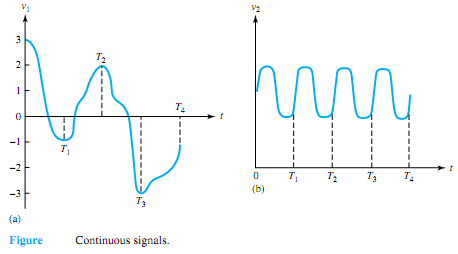
Whereas a continuous change from one value to another is the essential characteristic of an analog signal and continuous-state (analog) circuits are used to process analog signals, signals represented by discrete amplitudes at discrete times are handled by discrete-state (digital) circuits.

Analog systems process the information contained in the time function, which defines the signal, whereas digital systems, as the name implies, process digits, i.e., pulse trains, in which the information is carried in the pulse sequence rather than the amplitude-time characterization of the pulses. Figure illustrates continuous signals, whereas Figure depicts discrete signals. Consider Figure (a) to be a voltage signal (as a function of a continuous-time variable t) representing a physical quantity, such as the output voltage of a phonograph cartridge. The discrete signal (which exists only at specific instances of time) of Figure (a) has the same amplitude at times t = 0, T1, T2, and T3 as does the continuous signal of Figure (a). Figure 6.0.2(a) represents the sampled-data signal obtained by sampling the continuous signal at periodic intervals of time. The sequence of pulses in each time interval in Figure (b) is a numeric, or digital, representation of the corresponding voltage samples shown in Figure (a). Figure (b) may be considered as the signal, called a clock, which sets the timing sequence used in the generation of the pulses shown in Figure. An analog signal is an electric signal whose value varies in analogy with a physical quantity such as temperature, force, or acceleration. Sampling of an analog signalmakes it discrete in time.

A digital signal, on the other hand, can only have a finite number of discrete amplitudes at any given time. Through a process known as quantization, which consists of rounding exact sample
689_What do you mean by Digital Building Blocks.png

values to the nearest of a set of discrete amplitudes called quantum levels, a digitized signal can be obtained as discussed in more detail in Section.


Related Discussions:- What do you mean by digital building blocks

List out the reasons for automation, Describe the term (i) Automation ...

Describe the term (i) Automation (ii) Automated lines 04 List out the reasons for automation and discuss in detail the process of work part transport.

Evaluate the quiescent point of the circuit, Question: a). For the circ...

Question: a). For the circuit shown in figure state which operation is performed and draw the output waveform if measured between points A and B. The input signal is given in f

Electromechanical meters, Electromechanical Meters Electromechanical e...

Electromechanical Meters Electromechanical energy meters are based on the Ferraris Principle (see note in the margin). The working of these meters is explained. Working o

Self inductance , Self Inductance If a current is passed through a co...

Self Inductance If a current is passed through a coil, it creates a flux within the coil. Any attempt to change this flux will create a back emf that acts to oppose the chang

Compute the magnitude of the line-to-line voltage, Q. Three identical imped...

Q. Three identical impedances of 30 30° are connected in delta to a three-phase 173-V system by conductors that have impedances of 0.8 + j0.6  each. Compute the magnitude of the l

Merits and demerits of fixed bias with emitter resistor, Merits: The ci...

Merits: The circuit has the trend to stabilize operating point against changes in temperature and β-value. Demerits: In this type of circuit, to keep I C  independent o

Osillators.., what ie the use of mutual inductance in a hartley oscillator

what ie the use of mutual inductance in a hartley oscillator

Microprocessor, Memory map of tpa in a personal computer and explain such o...

Memory map of tpa in a personal computer and explain such of the areas in brief

Find the output voltage in full-wave rectified waveform, Q. The full-wave r...

Q. The full-wave rectified waveform, approximated by the first three terms of its Fourier series, is given by v (ωt) = V m sin (ωt/2), for 0 ≤ ωt ≤ 2π, and where V m = 100

Write Your Message!

Captcha
Free Assignment Quote

Assured A++ Grade

Get guaranteed satisfaction & time on delivery in every assignment order you paid with us! We ensure premium quality solution document along with free turntin report!

All rights reserved! Copyrights ©2019-2020 ExpertsMind IT Educational Pvt Ltd