Weight training calculations - artificial intelligence, Computer Engineering

Assignment Help:

Weight Training Calculations -Artificial intelligence:

Because we have more weights in our network than in perceptrons, first we have to introduce the notation: wij to denote the weight between unit i and unit j. As with perceptrons, we will calculate a value Δij to add up to each weight in the network afterwards an example has been tried. To calculate the weight changes for a specific example, E, first we begin with the information regarding how the network would perform for E. That's, we write down the target values ti(E) that each output unit Oi  would produce for E. Note that, for categorization problems, ti(E) will be 0  for  all  the  output  units  except  1,  which  is  the  unit  associated  with  the  right categorisation for E. For that unit, ti(E) will be 1.

736_Weight Training Calculations.png

Next, example E is propagated through the network so we may record all the observed values oi(E) for the output nodes Oi. At the same time, we record all the calculated values hi (E) for the hidden nodes. For each output unit Ok, then, we calculate its error term as follows:

1966_Weight Training Calculations1.png

The error terms from the output units are utilized to calculate error terms for the hidden units. In actual fact, this method gets its name because we propagate this information backwards through the network. For each hidden unit Hk, we calculate the error term in following manner:

In English language, this means that we take the error term for the entire output unit and multiply it by the weight from hidden unit Hk to the output unit. Then we add all these together and multiply the sum by hk(E)*(1 - hk(E)).

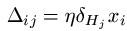
Having calculated all the error values connected with each unit (hidden and output), now we may transfer this information into the weight changes Δij between units i and j. The calculation is as following: for weights wij between input unit Ii and hidden unit Hj, we add on:

[Remembering that xi  is the input to the i-th input node i.e. E; that η is a small value known as the learning rate and that δHj is the error value we calculated for hidden node Hj utilizing the formula above].

For weights wij among hidden unit Hi and output unit Oj, we add on:
2491_Weight Training Calculations2.png

[Remembering that hi (E) is the output from hidden node Hi when example E is propagated through the network and that δOj is the error value we calculated for output node Oj utilizing the formula above].

2128_Weight Training Calculations3.png

Each alteration Δ is added to the weights and this concludes the calculation i.e. E. The next instance is then used to tweak the weights further. As with perceptrons, the learning speed is used to ensure that the weights are just moved a small distance for each particular example, so that the training for earlier examples is not lost. Note down that the mathematical derivation for the above calculations is based on derivative of σ that we discussed above. For total description of this, see chapter 4 of Tom Mitchell's book "Machine Learning".


Related Discussions:- Weight training calculations - artificial intelligence

Illustrate diffrent types of modems, Q. Illustrate Diffrent types of modems...

Q. Illustrate Diffrent types of modems? There are four different types of modems: half-duplex, full-duplex, synchronous, and asynchronous.With half-duplex modems data can be tr

How to use http and world wide web, Q. How to use Http and World Wide Web? ...

Q. How to use Http and World Wide Web? Http and World Wide Web One of the most frequently used services on the Internet is the World Wide Web (WWW). The application proto

For what purpose Karnaugh map is used, Karnaugh map is used for the purpose...

Karnaugh map is used for the purpose of ? Ans. Karnaugh map is used for, to minimize the terms in a Boolean expression.

What is ''LRU'' page replacement policy, 'LRU' page replacement policy is ?...

'LRU' page replacement policy is ? Ans. Least Recently Used.

Drill-down features provided by abap/4 in interactive lists, What are the d...

What are the drill-down features provided by ABAP/4 in interactive lists? ABAP/4 gives some interactive events on lists such as AT LINE-SELECTION (double click) or AT USER-COM

Sequence of micro -operations to perform a specific function, Q. Sequence o...

Q. Sequence of micro -operations to perform a specific function? A digital system executes a sequence of micro-operations on data stored in registers or memory. Specific sequen

Difference between narrative form and documentary form, Question: (a) E...

Question: (a) Explain clearly the difference between a Proposal and a Treatment for a video production project. (b) Explain clearly the difference between Narrative form an

What is known as multiphase clocking, What is known as multiphase clocking?...

What is known as multiphase clocking? When edge-triggered flip flops are not used, two or more clock signals may be required to guarantee proper transfer of data. This is calle

Registers used in organisation of an associative memory, In the organisatio...

In the organisation of an associative memory, many registers are used: Comparand Register (C): This register is used to grasp the operands, which are being searched for, or

Basic working of network layer, Q. Basic working of Network layer? Net...

Q. Basic working of Network layer? Network layer: Network layer is responsible for routing a packet within the subnet that is, from source to destination nodes across numerou

Write Your Message!

Captcha
Free Assignment Quote

Assured A++ Grade

Get guaranteed satisfaction & time on delivery in every assignment order you paid with us! We ensure premium quality solution document along with free turntin report!

All rights reserved! Copyrights ©2019-2020 ExpertsMind IT Educational Pvt Ltd