Wavy curve method, Mathematics

Assignment Help:

In order to compute the inequalities of the form

428_22.png


where n1, n2, ....... , n k , m1, m2, ....... , mp are natural and real numbers and a1, a2, ... , ak, b1, b2, ..., bp are any real number such that ai ≠ bj where i = 1, 2, 3, ....k and j = 1, 2, 3, ....p.


Method:

Step - 1 First place all values of x at which either denominator or numerator is becomes zero, that denotes a1, a2,....., ak, b1, b2, ....bp in ascending order say c1, c2, c3,....... cp + k. draw them on real line
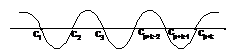
2149_22.png

Step -2  Value of x number at which numerator tends to zero could be remarked with dark circles.

Step - 3  All pints of discontinuities (x at which denominator tends to zero) could be remarked on number line with empty circles. Calculate the value of f(x) for any real number bigger than the right most checked number on the number line.

Step - 4  From right to left presented a wavy curve (beginnings above the number line in type of value of f(x) is positive in step-3 otherwise from below the number line), going thoroughly all the checked points. So that when goes through a point (exponent whose related factor is odd) intersects the number line, and when going thoroughly a point (exponent whose related factor is even) the curve doesn't cut the real line and stay on the similar side of real line.

Step - 5 The suitable intervals are selected in accordance with the sign of inequality (the function f(x) is positive wherever the curve is over the number line, it is negative if the curve is searched below the number line). Their union shows the solution of inequality


Related Discussions:- Wavy curve method

Inverse functions, Inverse Functions : In the last instance from the pr...

Inverse Functions : In the last instance from the previous section we looked at the two functions   f ( x ) = 3x - 2 and g ( x ) = x /3+ 2/3 and saw that ( f o g ) ( x )

Proof f(x) + g(x) dx = f(x) dx + g(x) dx anti-derivation, Proof of: ...

Proof of: ∫ f(x) + g(x) dx = ∫ f(x) dx + ∫g(x) dx It is also a very easy proof. Assume that F(x) is an anti-derivative of f(x) and that G(x) is an anti-derivative of

Equilibrium solutions, In the earlier section we modeled a population depen...

In the earlier section we modeled a population depends on the assumption that the growth rate would be a constant. Though, in reality it doesn't make much sense. Obviously a popula

Limit comparison test - sequences and series, Limit Comparison Test Ass...

Limit Comparison Test Assume that we have two series ∑a n and ∑b n with a n , b n   ≥ 0 for all n. Determine, If c is positive (i.e. c > 0 ) and is finite (i.e. c

Range of f(x) =4^x+2^x+1 is, Taking 2^x=m and solving the quadratic for get...

Taking 2^x=m and solving the quadratic for getting D>=0 we get range= [3/4 , infinity )

Finite math, Find the present value of an ordinary annuity which has paymen...

Find the present value of an ordinary annuity which has payments of 2300 per year for 15 years at 6% compounded annually

Concept, uses of maths concept

uses of maths concept

Basic statistics, #questio Study A Stu...

#questio Study A Study B Study C x2 = 1.683 F = 7.357 r = .83 df = 4

Write Your Message!

Captcha
Free Assignment Quote

Assured A++ Grade

Get guaranteed satisfaction & time on delivery in every assignment order you paid with us! We ensure premium quality solution document along with free turntin report!

All rights reserved! Copyrights ©2019-2020 ExpertsMind IT Educational Pvt Ltd