Utility maximisation - graphical presentation , Macroeconomics

Assignment Help:

Utility Maximisation:

Graphical Presentation 

Let consider a two-commodity world, x1 and x2 representing good I and good II respectively. p1 and p2 are the prices of good I and good II respectively, where the prices are given to the consumer, i.e., prices are exogenously given and consumer can't change them. Money income of the consumer is M, which is also exogenously given to the consumer. Note that p1x1+p2x2 is the total expenditure of the consumer when she consumes x1units of good I and x2 units of good two. The total expenditure of the consumer can't exceed her money income, therefore  p1x1 + p2x2 ≤ M  ------- (a)  

Equation (a) is known as consumer budget constraint. Let U = U(x1, x2) is the utility function of the consumer. Therefore, consumer must solve the following Maximisation problem(UMP):   
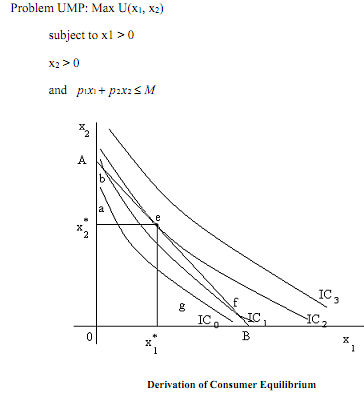
709_Utility Maximisation.png

As consumer objective is to maximise her utility and as larger consumption leads to larger utility, she always wants to consume more of any goods. But she also has to spend some amount of her income to consume larger amount of goods. So ultimately in equilibrium she will spend all her income and M = p1x1+p2x2.  

Consumer Behaviour  Now suppose that the line segment AB represents the budget line. Along AB p1x+ p2x2 = M  holds. Let initial indifference curve of the consumer is IC0. In IC0, there are many points along that indifference curve such that p1x+ p2x2 ≤ M holds. Therefore, utility maximising consumer will spend more as she moves to higher indifference curve (say IC1). In IC1 there are still such points along the indifference curve such that p1x+ p2x2 ≤ M  holds, so again consumer spends more. This process will continue as long as consumer reaches an indifference curve where for no point along the indifference curve p1x+ p2x2 ≤ M holds and at least one point of the indifference curve is on the budget line. At that point, we have consumer equilibrium, C(x1, x2) = (x1*(M,p1,p2), x2*(M,p1,p2))(in Figure point 'e' is the equilibrium point). Not that at equilibrium, slope of the indifference curve is equal to the slope of the budget line. Therefore, at equilibrium we have 

1) Budget constraint holds with equality sign. 

2) Slope of the indifference curve is equal to the slope of the budget line.   


Related Discussions:- Utility maximisation - graphical presentation

Estimated profit of typical start-up businesses, Typical start-up businesse...

Typical start-up businesses' estimated profit are forecasted as following: State Bad Good Probability 81% 21%

Single nonprofit provider, For a single nonprofit provider, describe an out...

For a single nonprofit provider, describe an output-maximizing model to predict supplier behavior.

Keynesian consumption function, How would I solve and graph this problem C=...

How would I solve and graph this problem C=$1 (trillion)+.80Yd

Write the mass balance equation, Environmental engineers and scientists are...

Environmental engineers and scientists are becoming concerned about pharmaceuticals in the environment. An antibiotic is discharged into a small lake at an influent concentration o

Labor supply and labor demand in the keynesian model, Supply of labor, L S ...

Supply of labor, L S (W/P), depends positively on real wages in classical model. It isn't always clear which individuals are included in the labor supply. Labor supply may consist

Explain short and long term interest rate in money demand, Explain about th...

Explain about the short term and long term interest rate in money demand. The Opportunity Cost of Holding Money Demand: a. Short-term interest rates Rates onto assets whi

Four different measures of GDP, Four different measures of GDP Using ci...

Four different measures of GDP Using circular flow model we see that there are 4 equivalent ways of measuring GDP:  Using the definition: market value of all finished goo

Potato chip industry in the northwest, In 2007, the potato chip industry in...

In 2007, the potato chip industry in the Northwest was competitively structured and in long-run competitive equilibrium; firms were earning a normal rate of return and were competi

Difference between Quantitative Easing and Monetary Policy, Why is quantita...

Why is quantitative easing used during liquidity trap when it lowers interest rates too?

Overnight interest rate of central banks, Overnight interest rate of Centra...

Overnight interest rate of Central banks When the central bank buys government securities, it purchases from many individuals, companies and institutions. Deposits and reserves

Write Your Message!

Captcha
Free Assignment Quote

Assured A++ Grade

Get guaranteed satisfaction & time on delivery in every assignment order you paid with us! We ensure premium quality solution document along with free turntin report!

All rights reserved! Copyrights ©2019-2020 ExpertsMind IT Educational Pvt Ltd