Unit card system - library management, Humanities

Assignment Help:

Unit Card System 

In an added entry we may record all the information that we have recorded in the Main Entry. Or, we may prefer to be brief in 4.2 Unit Card our description since full description is provided in the Main Entry and the user can refer to it if he wants to know the full details of the document. 

When we prepare entries manually handwritten or by typewriter we may prefer giving brief information in the added entries to save time and labour. 

With the aid of printing, duplicating mechanically by photo copying methods, an exact replica of the Main Entry can be produced. 

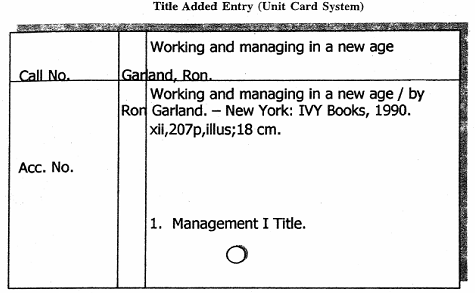
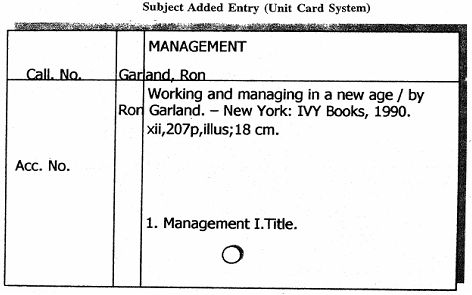
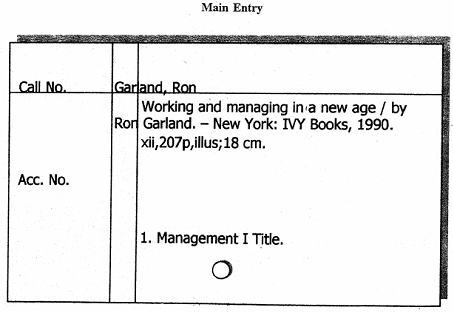
In what is known as 'Unit Card' or 'Unit Record System', the Main Entry and the added entries carry the same information about the document. The only difference between them is that each added entry will have the approach element at the top of the entry starting from the second indention. In such cases the Main Entry is known as 'Unit Entry'. 

We may note here the current thinking on the Unit Record System and the Main Entry. Once every entry for all possible access points of a document carries full description, there may not be any need to call any one of the entries as Main Entry. Bhodan S. Wynar observes "many people believe that when multiple access points are readily available, and when the bibliographic description is complete by itself, there is no need to designate one, of the access points as the "main" one. This concept may then disappear in future codes". 

The entries in Unit Card System appear as:    
2190_main entry.png 

2283_main entry1.png

1479_main entry2.png

When the information given in the added entry is brief, the above subject heading which is added to the entry looks like the one below:    

2121_main entry3.png

Note that in this type of brief added entry, only the Call Number, author, title and year of publication are given. Sometimes even the year is omitted. The main line is now occupied by the added entry element but this element starts from the second indention, which indicates that the entry is not a main entry.  


Related Discussions:- Unit card system - library management

Data elements in a dictionary catalogue, DATA ELEMENTS IN A DICTIONARY CATA...

DATA ELEMENTS IN A DICTIONARY CATALOGUE   We shall discuss the parts of main entry in a dictionary catalogue according to ISBD and AACR-2R with their purpose, and they are iden

Essential Points To Be Put Into Practice To Enhance The Trad, What is the c...

What is the citation for Bernice Bleedorn''s quotation at the end of the article, please?

Tracing - purpose of catalogue entry, Tracing   Tracing is a separate p...

Tracing   Tracing is a separate paragraph. This is the last paragraph in the Main Entry of a Dictionary Catalogue., This part traces the additional entries that are provided fo

Definition of an indexing system, Definition of an Indexing System   Le...

Definition of an Indexing System   Let us now look at some of the definitions available in the literature of Library and Information Science. One such definition states that "a

State formation in north america, The story of state formation in North Ame...

The story of state formation in North America is similar. One difference is that the struggle for territory after the beginnings of European settlement was initially driven exogeno

Word arrangement and word treatment-evaluation of dictionary, Word arrangem...

Word arrangement and word treatment In most of the dictionaries, entries are arranged in alphabetical order. The arrangement of the vocabulary is either letter-by-letter or wo

Identifying the cultural and social factors , Classify one emerging technol...

Classify one emerging technology and evaluate its future prospects by identifying the cultural and social factors that may prevent or promote its successful application.  Use concr

American exceptionalism, I want to start by calling in question three popul...

I want to start by calling in question three popular beliefs that may prove to be interrelated myths. First, the common assumption that the usa is essentially European in character

Sociology, What is the difference between tribe and caste

What is the difference between tribe and caste

Non conventional indexing model - citation indexing, NON CONVENTIONAL INDEX...

NON CONVENTIONAL INDEXING MODEL - CITATION INDEXING Another unique indexing model was developed by Eugene Garfield in early 1960's. The model is non conventional in the sense

Write Your Message!

Captcha
Free Assignment Quote

Assured A++ Grade

Get guaranteed satisfaction & time on delivery in every assignment order you paid with us! We ensure premium quality solution document along with free turntin report!

All rights reserved! Copyrights ©2019-2020 ExpertsMind IT Educational Pvt Ltd