Treasury yield curve, Financial Management

Assignment Help:

Treasury securities are government bonds issued by the US Treasury Department. These are issued through the Bureau of the Public Debt. They are debt-financing instruments of the US Federal government. These securities are of four types - Treasury Bills, Treasury Bonds, Treasury Notes and Savings Bonds. All these securities, except savings bonds are highly liquid and heavily traded in the secondary stock markets.

In treasury securities, there exist on-the-run treasury securities and off-the-run treasury securities. The on-the-run treasury securities are the most recently issued US Treasury bonds and notes. Normally, stockbrokers acquire these securities in large quantities and sell them to retail investors. These securities are highly liquid and are traded at higher prices when compared to that of off-the-run treasury securities. Off-the-run treasury securities are those treasury securities, which are issued, in earlier auctions.

These securities are fixed income instruments and are free from credit risk. These securities provide low yield when compared to that of non-treasury securities. This is due to their favorable tax treatment, high liquidity, being free from credit risk, and being non-callable securities.

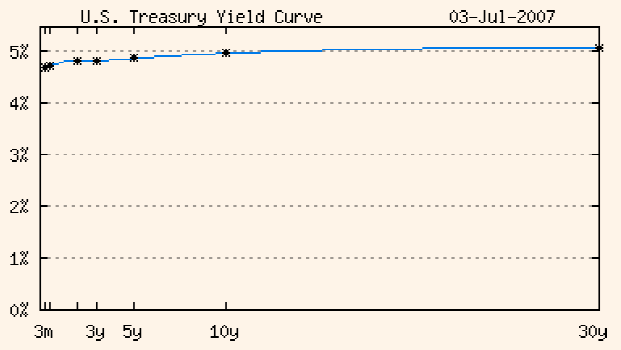
The relationship between the yields offered on the treasury securities for each maturity when represented graphically is refereed to as treasury yield curve. A yield curve may be an upward sloping yield curve (longer the maturity, higher the yield), inverted yield curve (longer the maturity, lower the yield), or a flat yield curve (same yield regardless of maturity).

Figure 1: US Treasury Yield Curve
 

1523_us treasury yield curv.png

Table 1

Maturity

Yield on 03.07.2007

Yield on 02.07.2007

3 Month

4.71

4.65

6 Month

4.74

4.71

2 Year

4.83

4.85

3 Year

4.83

4.87

5 Year

4.87

4.91

10 Year

4.97

5.01

30 Year

5.07

5.10

 From the above two exhibits, it is clear that the longer the maturity, the higher will be the yield. Due to this feature, treasury yield curve is also known as the 'upward sloping yield curve' or the 'normal yield curve'.


Related Discussions:- Treasury yield curve

Between entries for routine business transactions, Ivan is making several e...

Ivan is making several entries into the general journal at the restaurant where he serves as an accountant. The main difference between entries for routine business transactions an

Calculate the future value of annuity, 1.  An investor is thinking of inves...

1.  An investor is thinking of investing in a recurring deposit scheme that offers an interest rate of 12% per annum. The investment that he is planning is for the higher education

Types of rating - individual/borrower rating, Individual/Borrower Rating ...

Individual/Borrower Rating This includes rating a borrower to whom a loan/credit facility may be sanctioned.

Determine the operating profit of the firm, 1. The Gulf had sales of  AED 2...

1. The Gulf had sales of  AED 20,000,000 and cost of goods sold of  AED 10,250,000. Selling and administrative expenses represented 8 percent of sales. Depreciation was 5 percent o

Types of capital budgeting, Types of Capital Budgeting Decisions: A bu...

Types of Capital Budgeting Decisions: A business organization has to quite normal face the problem of capital investment decisions. Capital investment defines as the investmen

Explain gresham’s law, Explain Gresham’s Law. Answer:  Gresham’s law cons...

Explain Gresham’s Law. Answer:  Gresham’s law considers to the phenomenon that bad (abundant) money drives good (scarce) money out of circulation. This type of phenomenon was fre

Define a preemptive right protect the interests, How does a preemptive righ...

How does a preemptive right protect the interests of existing stockholders? A preemptive right defends the interests of existing stockholders by providing them the opportunity to

Causes of risks, Q. Causes of Risks 1) Wrong decision of what to invest...

Q. Causes of Risks 1) Wrong decision of what to invest in. 2) Wrong timing of investments. 3) Nature of instruments invested such as shares or bonds, chit funds, benefit

Components of working capital, Examine the components of working capital & ...

Examine the components of working capital & also explain the concepts of working capital.

Expalin the term mutual funds, Mutual funds Mutual funds pool resources...

Mutual funds Mutual funds pool resources from a lot of individuals and companies and invest these resources in diversified portfolios of bonds, stocks and money market instrume

Write Your Message!

Captcha
Free Assignment Quote

Assured A++ Grade

Get guaranteed satisfaction & time on delivery in every assignment order you paid with us! We ensure premium quality solution document along with free turntin report!

All rights reserved! Copyrights ©2019-2020 ExpertsMind IT Educational Pvt Ltd