Traditional mortgages, Financial Management

Assignment Help:

In US, savings and loan associations constitute the major originating group of the traditional loans. What types of properties can be mortgaged? Virtually all forms of real estate can be mortgaged, though they fall into several categories: Residential and Non-residential, etc. The traditional mortgages exhibit the following features:

  • A fixed rate of interest is charged on the loan for its entire term.

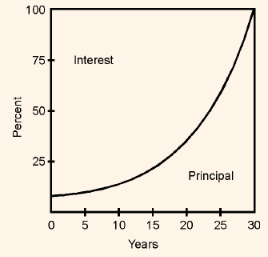
  • Loan is repaid in equated monthly installments consisting of both principal and interest. At first, the mortgage payments are mostly interest payments. As the principal outstanding declines, the interest portion of the monthly payments also declines and the principal portion increases.

Consider a 30-year 10% traditional mortgage for a loan of $100,000. The monthly payment and the break up between principal and interest will be as under:

Table 1: Traditional Mortgage (10% Interest Rate, 30-Year Term)

Month

Mortgage Balance at the end of the Month

Monthly Payment

Interest

Principal

   0

1,00,000.00


   1

   99,955.76

877.57

833.33

  44.24

   2

   99,911.16

877.57

832.96

  44.61

   3

   99,866.18

877.57

832.59

  44.98

   -


  - 


100

   93,135.76

877.57

776.96

100.61

101

   93,034.32

877.57

776.13

101.44

102

   92,932.04

877.57

775.29

102.28

  -


  -


300

   41,303.22

877.57

348.60

528.96

301

   40,769.84

877.57

344.19

533.38

  -


   -


358

   1,733.44

877.57

21.57

860.00

359

      870.32

877.57

14.45

863.12

360

                0

877.57

  7.25

870.32

Note: Each month, the interest payment is 1/12 of 10% of the mortgage balance at the end of the previous month. The principal payment is the total payment less interest. Total payment is the equated monthly payment calculated as
100,000 ¸ PVIFA(10/12,360).

Table 1 illustrates the break down of interest and principal components. At first, the mortgage payment is mostly interest and it gradually decreases as maturity approaches and on maturity, the payment is entirely the principal.

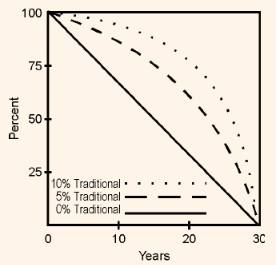
The amount of principal outstanding at any time is referred to as the mortgage balance. The amount of a home's value that is owned is referred to as homeowner's equity. The difference between the current market value of the home and the mortgage balance equals the homeowner's equity and as the mortgage balance declines, the equity rises.

Figure 1: Monthly Mortgage Payments - 

Interest/ Principal (30-year, 10% Conventional Loan)
785_monthly mortgage payment.png

Figure 2: Examples of Mortgage Balances for Various Loans
2336_monthly mortgage payment1.png

Figure 2 shows how the mortgage balance for several possible loans would decline over a time period.


Related Discussions:- Traditional mortgages

Deriving 6-month forward rates, Using details from table 8, let us co...

Using details from table 8, let us compute the 6-month forward rate. Simple arbitrage principle, like the one used to compute the spot rates are used in this proc

How are libor, Q. How are LIBOR, TIBOR and EURIBOR determined? London I...

Q. How are LIBOR, TIBOR and EURIBOR determined? London Inter Bank Offered rate ( LIBOR) and is the rate of interest at which banks offer funds to other banks in marketable siz

Review of financial research report, This assignment is an analysis of a U....

This assignment is an analysis of a U.S. publicly-traded company; its common stock could be a prospective investment. The report is due in Week 10, in needs to be at least 5 pages

Participants in secondary market, PARTICIPANTS IN THE SECONDARY MARKET ...

PARTICIPANTS IN THE SECONDARY MARKET The players in the secondary capital market include: Individual Investors (Public). Companies. Mutual funds. Financial Insti

Define the term corporate and financial relations, Question: (a) Define...

Question: (a) Define the term "corporate and financial relations" and clearly state its components. (b) By using one example, identify the steps required to establishing cor

Define the term- cost of capital, Define the term- Cost of capital Cost...

Define the term- Cost of capital Cost of capital is the rate of return a firm should earn on its investments for the market value of the firm to remain unchanged. Acceptance of

Cash outflows and income statement of a company, a. You only need to compl...

a. You only need to complete the 2012 column, leave the 2011 column as is. b. Base you net income and certain other information needed from the income statement you completed in

The standard contribution rate and actuarial liability, Question 1: Giv...

Question 1: Give the formulae for the Standard Contribution Rate (SCR) and Actuarial Liability (AL) for each of the following funding methods: a) Credit Unit Method b)

Find out eps, The financial manager of A ltd.co. expects that its EBIT in t...

The financial manager of A ltd.co. expects that its EBIT in the current year is 10,000. The firm has 5% Deb. Amounting to Rs. 40,000., while 10% Pref. Share amounts to Rs. 20,000.

Write Your Message!

Captcha
Free Assignment Quote

Assured A++ Grade

Get guaranteed satisfaction & time on delivery in every assignment order you paid with us! We ensure premium quality solution document along with free turntin report!

All rights reserved! Copyrights ©2019-2020 ExpertsMind IT Educational Pvt Ltd