The operational amplifier :
The integrated circuit operational amplifier is one of the most useful and versatile electronic devices available today. The name 'operational amplifier' is not new; it refers to a type of amplifier originally used in analogue computing to perform mathematical operations - e.g. multiplication or division by a constant. The modern integrated circuit device can be adapted (by feedback) to perform most general-purpose amplifier duties, as well as its use in mathematical operations.
The Op Amp can consist of many stages of amplification to ensure high gain, and will be arranged to have two input terminals, two power supply terminals and an output terminal. In addition it will normally have terminals for setting the output to zero when the input is zero.
The Op Amp consists of a transistor circuit of considerable complexity, which has been found so useful that the whole circuit is manufactured on a single piece of silicon, fitted with input and output leads, and covered in plastic. It is the first "Integrated Circuit", and can be treated just as if it were a new component. Figure shows a type 741 Op Amp and circuit.
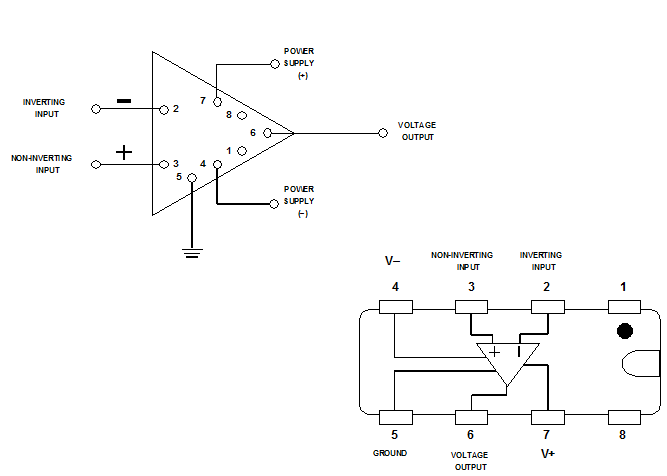
In the Op Amp, two pins are marked supply + and supply - and are connected to the amplifiers power supply. The device also has two inputs, the "Inverting input" (VI) identified by a negative symbol. A "Non inverting input" (VN) identified by a positive sign and a single output (VO).
Note: The negative/Positive signs on the inputs does not mean that negative/positive signals are applied, but identify the inverting and non-inverting terminals.
The VI, VN and VO are the values of the voltages applied to the inputs and obtained form the output. These voltages are joined by the equation:
VO = AO (VN - VI)
Here we have a slight problem. Voltages are measured between one point in a circuit and another. Usually one point is the negative or zero line. When calculating VN & VI it does not matter were the reference is as long as it is the same for both voltages. When we obtain the output VO we need to know the reference point used by the Op Amp. This is not the zero line but a voltage halfway between the positive supply and the zero line.
The other unknown quantity in the equation is AO, the "Open Loop Gain". This gain is constant for each particular Op Amp and is the ratio between two voltages. Open Loop gain in Op Amps is normally 105.