Tasks, predecessors and times - process design, Operation Management

Assignment Help:

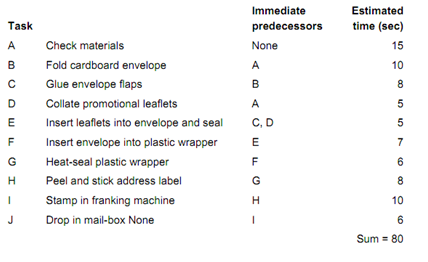
Tasks, Predecessors and Times - Process Design
1329_Tasks, Predecessors and Times - Process Design 1.png

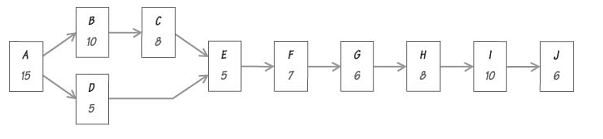
The first step in the procedure is to draw a precedence diagram, shown here, the task labels and times entered in the nodes.

The next step is to determine the cycle time required to deliver the stipulated rate of output: 

Time cycle = productive time available per hour / output per hour

3600 output per hour / (8,000/5*8)) mail shots per hour = 18 seconds

We then calculate the theoretical minimum number of workstations required. This would be the result if it were possible to design the line such that the task times were evenly spread among the workstations; a very unlikely outcome in practice. However, as we will see later, it can be used to assess the utilisation of the practicable line layout produced by the procedure.
286_Tasks, Predecessors and Times - Process Design 2.png

Theoretical minimum number of workstation = Sum of task times/cycle times = 80/18

=4.4 workstations

The next stage, the allocation of tasks to workstations, is usually conducted by heuristic (ie rule-of-thumb) methods. There are several such heuristics; we will use one of the simpler ones, the longest-task- time heuristic, the results of its application being displayed in the table below. It begins with the first workstation and consideration of the candidate tasks that could be allocated to it. In this case there is only one candidate, 'A', since no other task can begin until 'A' is complete. 'A' is allocated, its time entered, and the remaining unassigned part of the 18-second cycle time calculated and entered (18 - 15 = 3 seconds).


Related Discussions:- Tasks, predecessors and times - process design

Explain important in work-center scheduling, Why is managing bottlenecks so...

Why is managing bottlenecks so important in work-center scheduling?

Explain implications of the competitive advantage of nations, Porter's Five...

Porter's Five Forces Model and the implications of the Competitive advantage of Nations' research on this model

Explain disadvantages of giving teams a lot of autonomy, Using terms from t...

Using terms from this chapter, how would you characterize the teams at ICU Medical Inc.? What are some advantages and disadvantages of giving teams a lot of autonomy to make decisi

Explain delays in the project mean that the center, Your in charge of a pro...

Your in charge of a project at the local community center. The center needs to remodel one of the room in time for the start of a new program. Delays in the project mean that the c

Distinguish between legal and employee rights, Q1. What is the biggest chal...

Q1. What is the biggest challenge posed by egoisn Q2. Distinguish between legal and employee rights Q3. How is strategy different from a business model? How is it similar?

Plant location, factor relating methods for locating a plant

factor relating methods for locating a plant

Determine the overall project completion time, Question : (a) Under wha...

Question : (a) Under what conditions is PERT preferred to CPM in project management ? Illustrate your answer with examples of projects. (b) Several stages are involved in

Explain what is my alternative hypothesis, In preparing a survey to be admi...

In preparing a survey to be administer to my university peers, it is necessary to tabulate these data once collected. How should the data be tabulated and what statistical methods

Explain shipments to just-in-time, Why are organizations changing from batc...

Why are organizations changing from batch (large) shipments to just-in-time (JIT) shipments?

Write Your Message!

Captcha
Free Assignment Quote

Assured A++ Grade

Get guaranteed satisfaction & time on delivery in every assignment order you paid with us! We ensure premium quality solution document along with free turntin report!

All rights reserved! Copyrights ©2019-2020 ExpertsMind IT Educational Pvt Ltd