Surgery in iron age, Science

Assignment Help:

Surgery:

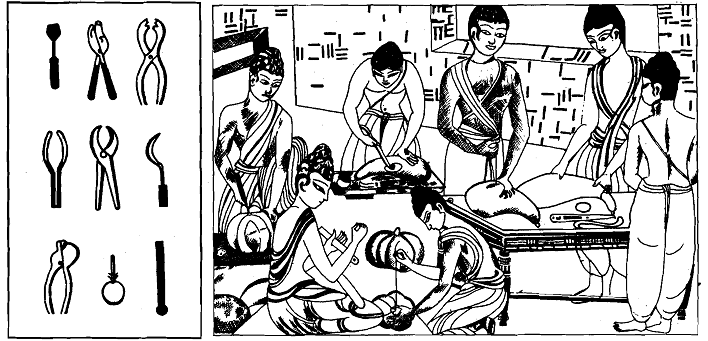
Susruta-Samhita,  a.major  treatise on surgery, was derived not only from exhaustive observation of symptoms of diseases  and their possible treatments but also a fairly detailed knowledge of human physiology, anatomy,  and especially the internal organs. For example, in  treating ulcers or wounds, it is directed that the instruments should be introduced with the precaution of avoiding dangerous places, such as veins, bones and the like, until the pus is visible. In  the Sarnhita  there is also detailed description of different  types of  iron instruments, made by  local smiths  for extraction,  cutting etc., in terms of sharpness, shape and size. Two interesting  features  of  this treatise are: 

i)  Scrupulous attention to pre and post-surgical cleaning of  the wound, implying some empirical knowledge of  infection, and .  

ii) use of anaesthetics. While instructions are given to  bind the patient strongly so  that he could not move during the operation, it is also mentioned that he should be given wine to drink before the operation so that he might not faint and might not feel the knife.  
84_surgery.png

Thus, we find that in  Iron Age India, a scientific  approach and method was adopted in  the practice of medicine. It is not surprising that the scientific practices of Carakas and Susrutas earned the wrath and displeasure  of  the priests. This was, possibly, because their practices often contradicted the prevailing ideas of priests who earned their living by  reciting dictums such as "the gods are fond of  the obscure" or "the gods are fond of  the obscure, they detest direct observation." In the practice of medicine, the Indian physicians did not distinguish between the upper and the  lower castes in terms of  their medical attention. This was another reason why  they were not too popular with the priests.  


Related Discussions:- Surgery in iron age

Normal limits and factor scales, Factor Scales Mr. X is not overtly ex...

Factor Scales Mr. X is not overtly expressing any form of generalized distress or negative emotionality; he is extroverted and verbally fluent (A= 39, PSYC=40, NEGE=43). Howev

Explain thiamin (vitamin b1), Thiamin (vitamin B1) Thiamin was  first  ...

Thiamin (vitamin B1) Thiamin was  first  isolated  in  1926 from rice polishing by  Jansen  and Donath.  Its empirical formula was established  in  1931  by  Windaus  and  co-w

Fst 01, describe briefly the scientific and technical achivement of the bro...

describe briefly the scientific and technical achivement of the bronze age

What is hydrolysis, What is hydrolysis Fats when  boiled with  water  a...

What is hydrolysis Fats when  boiled with  water  at  220°C  under  pressure  in  an  autoclave,  undergo hydrolysis to first form a diglyceride and then ultimately glycerol an

Animals, what are the kinds of animals?

what are the kinds of animals?

A&P, Most of the plasma is composed of?

Most of the plasma is composed of?

Perkins condensation, is perkin''s condensation possible in aliphatic aldeh...

is perkin''s condensation possible in aliphatic aldehyde?

Giraffes, does giraffes have short necks?

does giraffes have short necks?

Which type of rock is critical for the formation of geysers, Which type of ...

Which type of rock is critical for the formation of geysers? Liquid rock is required for geysers to type in the form of what is known as magma - which is the geological name fo

Explain about the soil formers, Explain about the soil formers Soil dev...

Explain about the soil formers Soil development or soil genesis as it is called, is the result of a number of factors such as parent material, topography, time, climate and bio

Write Your Message!

Captcha
Free Assignment Quote

Assured A++ Grade

Get guaranteed satisfaction & time on delivery in every assignment order you paid with us! We ensure premium quality solution document along with free turntin report!

All rights reserved! Copyrights ©2019-2020 ExpertsMind IT Educational Pvt Ltd