Sudoku class used in java program, JAVA Programming

Assignment Help:

Sudoku Class (Simple Version)

The Sudoku class will encapsulate the minimum necessary data and logic to manipulate, print, and set the SudCells, in anticipation of a higher level Solver class.  This should not contain logic that is about the solution algorithm.  There is a little wiggle room in here, because you do have to allow the basic maneuvers that a Solver class would need, and these might be considered part of the algorithm, but I have determined where to draw the line for you, and you will see this in the choice of my included methods.

The most obvious data structure that Sudoku must contain is a 2-D array (matrix) of SudCells.  The second aspect of this class is the grouping of nine small 3x3 sub-matrices which most people call groups or blocks, but I wanted to call Sectors. Here is a picture of the data organization of a Sudoku object for our project:
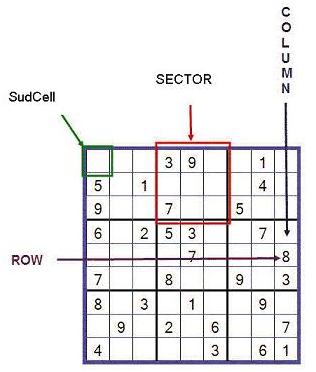
2143_Sudoku Class.png

It is made up of SudCell objects (informally, "cells"), but we also want use the terms row, column and sector when describing fundamental operations that our Solver might need.  For instance the Solver might ask the Sudoku to "force the number 1 into cell (2, 3)" (row two column three).  Or maybe it needs to say, "rule out the value 9 from cell (5, 1)". It may need to ask, "how many possible digits (true values) are left in cell (1, 1)?"

There will also be a few methods that border on Solver actions, but they are so fundamental that we can safely put them into the Sudoku class.  For example, we want a method that tells us when the Sudoku is solved. In our implementation, I provide a method that returns true if each cell has only one remaining value (only one true in the digits[] array).  Similarly, there are methods that total up all the remaining un-ruled out values for the entire 9x9 suds[] array, something that will be helpful for algorithms to know ("have we ruled out any new values since the last rule we applied or are we going around in circles?")

In summary, our Sudoku class will have to collect 81 SudCells in a 9x9 matrix, but also superimpose nine 3x3 sectors on these same SudCells.  It will have to have accessor-like and mutator-like methods to inquire about and make changes to individual SudCells based on row, column and sector.  Because the nine sectors are very tricky, this will not be done in Option A.  If you are up to the challenge, you would attempt that in intermediate/advanced options.


Related Discussions:- Sudoku class used in java program

File I/O, Write a program that reads both the girl and boy files into memor...

Write a program that reads both the girl and boy files into memory using arrays. Then, allow the user to input a name. The program should search through both arrays. If there is

How dos attack is a cyber crime what cyber crime can be used, How DoS attac...

How DoS attack is a cyber crime? For what cyber crime can be used? DoS stands for Decline of Service and it is a cyber crime as it jams and within a few cases shut down the goa

Program on while and until loop, Question Based on the program fragmen...

Question Based on the program fragment below, rewrite the outer for loop using: a. while loop b. repeat..until loop

Give an examples of java.lang.math methods, Give an Examples of java.lang.M...

Give an Examples of java.lang.Math Methods Here is an instance program in which exercises most of the routines in java.lang.Math. If your high school math is a little rusty, do

Tokenizer, To load a text-file, read it line by line, and return the total ...

To load a text-file, read it line by line, and return the total number of alphanumeric tokens it contains and skip over the comments and double-quoted strings in the text-file whil

What are the non-final functions in java object class?, The non-final funct...

The non-final functions are clone (), finalize (), toString (), equals () , hashCode () and. The other methods like wait (), getClass (), notifyAll (), notify () etc are final

Difference b/w deep cloning and shallow cloning of object, The default natu...

The default nature of an object's clone() function automatically provides a shallow copy. So to need a deep copy the classes have to be edited or adjusted.   Shallow co

Explain JMS, JMS ((java messaging service))is an acronym used for Java Mess...

JMS ((java messaging service))is an acronym used for Java Messaging Service. It is Java's answer to formed software using asynchronous messaging. It is one of the official specific

Advantages java layout managers over traditional windowing, What are the ad...

What are the advantages that Java's layout managers provide over traditional windowing systems ?

Write the hashcode() method of java.lang.object, Write the hashCode() metho...

Write the hashCode() method of java.lang.Object Anytime you override equals() you should also override hashCode(). The hashCode() method should ideally return the similar int f

Write Your Message!

Captcha
Free Assignment Quote

Assured A++ Grade

Get guaranteed satisfaction & time on delivery in every assignment order you paid with us! We ensure premium quality solution document along with free turntin report!

All rights reserved! Copyrights ©2019-2020 ExpertsMind IT Educational Pvt Ltd