Structured data, Python Programming

Assignment Help:

Structured data

We will often  want  to work  with  large  groups of data.   Rather  than  providing  each  number its own  value,  we need  to manage the data  into natural structures: grocery  lists, matrices, groups of employee medical records. We will explain  a simple  but  enormously useful  and ?exible list, which is conveniently create into Python: the list. The precise information  of how lists are shown inside a computer vary from language to language. We will take an abstract model  in which we think of a list as an ordered sequence of memory locations that numbers. So, for example, in Python, we may show a list of three integers as:
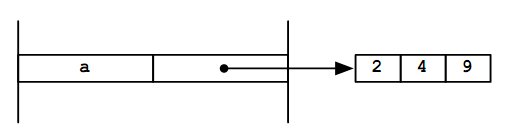
 

644_structured data.png


Now that we have lists, we have some new kinds  of statements, which let us extract elements of a list by specifying their indices.   An index  of 0 related to the ?rst  element of a list.  An index  of -1 related to the last element So, if a is bound as above, then we would have:


>>> a[0]

>>> a[2] 

>>> a[-1] 

>>> a[3] 


Traceback (most recent call last): File "", line 1, in IndexError: list index out of range.Note that if we attempt to access an element of the list that is not present, then a exception is generated.


847_structured data  2.png


It is also possible  to have  an empty list, which  is given in Python as []. We will show it in our memory diagrams as a short box. So example, this list  looks like this in memory:

>>> z = [3, [], [[]]]


515_structured data  3.png


Python has a useful method, len, which takes a list as an argument and gives its size. It does not look inside  the elements of the list-it just returns the number of elements at the top level of list. So, we take


>>> len([1, 2, 3])

3

>>> len([[1, 2, 3]])

1


Related Discussions:- Structured data

Example of python code, Worked example 1   Let's examine what  happens...

Worked example 1   Let's examine what  happens when  we compute the following Python code:   def p(x, y): z = x*x - y return z + 1/z   >>> p(1.0, 2.0) -2.0

Basic-learning to program in python , Depending on your  previous programmi...

Depending on your  previous programming background, we use different sides  through the available readings:   If you have never programmed before: you should start with a

Algorithms, Write an algorithm for the sum of the given series 1,-1/2,1/4,-...

Write an algorithm for the sum of the given series 1,-1/2,1/4,-1/8.....

Procedures in python, Procedures in python Procedures are computer pro...

Procedures in python Procedures are computer program creates that let us capture common patterns of computation by: Grouping together sequences of statements

Lists, Python has  a built-in list data  structure that  is easy  to use  a...

Python has  a built-in list data  structure that  is easy  to use  and  incredibly convenient.  So, for that point, you can say >>> y = [1, 2, 3] >>> y[0] 1 >>> y[2]

Python programs, Python programs Every  general-purpose computer has a...

Python programs Every  general-purpose computer has a various detailed design, which  defines  that  the way  its program requires  to be specified is different. The "machine

Prime number, Use the function to compute and print the sum of first n prim...

Use the function to compute and print the sum of first n prime numbers.

Foundation of programming, hi i want to make a assignmnt of foundation of p...

hi i want to make a assignmnt of foundation of programming which include 4 task. I just want to know how much will be the price for that

Write Your Message!

Captcha
Free Assignment Quote

Assured A++ Grade

Get guaranteed satisfaction & time on delivery in every assignment order you paid with us! We ensure premium quality solution document along with free turntin report!

All rights reserved! Copyrights ©2019-2020 ExpertsMind IT Educational Pvt Ltd