Spontaneous Generation:
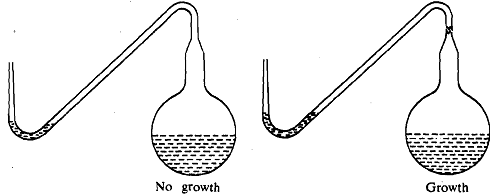
If we look around at our everyday environment, we observe that straw, soil, mud, dirt, indeed any sort of refuse or rotting matter is infested with a wriggling, moving multitude of living organisms. Such observations led people to believe that life originated spontaneously from non-living matter. Aristotle (384-322 B.C.), known as the father of biology, maintained that not only worms and insects, but also fish, frogs and mice couli spring from suitable breeding materials like filth and moist soil. Even man might have had a similar origin! This theory of spontaneous generation was disproved by the experiments of the French microbiologist Louis Pasteur aslate as 1862. It was not easy to dislodge Aristotelian ideas. It took all the ingenuity and experimental skill of Louis Pasteur to disprove the theory of spontaneous generation. Pasteur performed his experiment before a gathering of well-known biologists of the time, who were commissioned by the Academy of Sciences of France to test his hypothesis, that only "life begets life". For his experiment, Pasteur took two flasks, half filled them with yeast infusion containing a little bit of sugar and heated them so as to kill any living organisms. He sealed the mouth of one of the flasks and left the other open to the air. After a few days, he invited His friends to observe what had happened. To their surprise, they found that the closed flask was still free of any living organism while the open one was infested with living organisms. In fact one of these sealed flask is still kept at the Academy of Sciences in Paris. Even after more than a hundred years, there are no living organisms in it. However, to further remove any doubt that organisms did not grow in the sealed flask due to lack of oxygen, Pasteur repeated the experiment with swan necked flasks which were left open. The gooswan-neck would enable the air to get in, but would prevent any living organisms from getting into the infusion. Again no organisms grew in these flasks.
Pasteur's studies helped to solve many problems related to brewing of wines. Wine making was an important industry in France at the time and 'souring of wine' or wine going bad was threatening this industry at that time. Pasteur showed that if certain harmful organisms could be kept out during the brewing process, wine would not sour. These studies had a profound effect in another area also, namely that of surgery. Surgical wounds and injuries used to get infected invariably. So much so, that if one did not die of injury, one would certainly die of infections caught from surgical instruments, bandages etc. Taking Pasteur's work as the basis, it was postulated that if the wounds could be kept 'clean', i.e. if disease producing germs could be prevented from getting into a wound, it would not get infected and would heal better.