Sorting using interconnection networks, Computer Networking

Assignment Help:

The combinational circuits use the comparators for comparing the storing and number them on the basis of minimum and maximum functions. Likewise, in the interconnection networks the two processors perform the computation of minimum and maximum functions in the following way:

Let us consider there are two processors pj and pi. Each of these processors has been given as input a part of the sequence, say ej and ei. Now, the processor pi sends the element ei to pj and processor pj sends ej to pi. After that, processor pi determine the minimum of ei and ej i.e., min (ei,ej) and processor pj determine the maximum of ei and ej, i.e. max (ei,ej). The above method is called as compare-exchange and it has been depicted in the Figure .
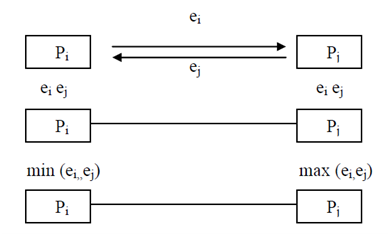
581_Illustration of Exchange-cum-Comparison in interconnection networks.png

                                                          Illustration of Exchange-cum-Comparison in interconnection networks

 The sorting problem chosen is bubble sort and the interconnection network can be depicted as n processors interconnected with each other in the type of a linear array as given in Figure. The method adopted for solving the bubble sort is called as odd- even transposition. Suppose an input series is B=(b1, b2, b3, b4......... bn) and each number is assigned to a particular processor. In the odd-even transposition,the sorting is executed with the help of two phases known as odd phase and even phase. In the odd phase, the elements stored in (p1, p2), (p3, p4), (p5, p6)......... (pn-1, pn) are compared according to the Figure and consequently exchanged if required i.e. if they are out of sort. In the even phase, the elements stored in (p2, p3), (p4, p5), (p6, p7)......... (pn-2, pn-1) are compared according to the Figure and consequently exchanged if required, i.e. if they are out of order. keep in mind, in the even phase the elements stored in p1 and pn are not exchanged and compared. The total number of phases needed for sorting the numbers is n i.e. n/2 odd phases and n/2 even phases. The algorithmic representation of the above discussed odd- even transposition is given below:

2084_Interconnection network in the form of a Linear Array.png

                                                Interconnection network in the form of a Linear Array


Related Discussions:- Sorting using interconnection networks

What are the routing techniques, Q. What are the Routing Techniques? R...

Q. What are the Routing Techniques? Routing Routing Techniques Static versus Dynamic Routing Routing Table for classful Addressing Routing Table for Cl

What is nic and wan, What is NIC and WAN? NIC is short for Network Inte...

What is NIC and WAN? NIC is short for Network Interface Card. This is a peripheral card that is joined to a PC in order to connect to a network. Each NIC has its own MAC addres

What is a web server, This new model of Client/Server having of thin, porta...

This new model of Client/Server having of thin, portable, "universal" clients those talks to super fat servers. In the easiest form, a web server returns documents when clients ask

Ip checksum, This code properly implements the IP checksum function on a 32...

This code properly implements the IP checksum function on a 32-bit machine: unsigned short cksum(unsigned short *buf, int count) { unsigned long sum = 0; while (count--) { sum += *

Explain clustering support, Explain clustering support Clustering suppo...

Explain clustering support Clustering support refers to the ability of a network operating system to link multiple servers in a fault-tolerant group. The main purpose of this i

Example of go back - N protocol, Q. Example of go back - N protocol? Th...

Q. Example of go back - N protocol? The window size is 4. A sender has sent frame 6 as well as the timer expires for frame 3 (frame 3 not ACKn'd). The sender goes back as we

Http is stateless - discuss this statement, Question : (a) Describe, w...

Question : (a) Describe, with the aid of a diagram, a hybrid topology of a network of your choice. (b) Briefly explain the similarity and differences between a switch and

Describe unbound transmission media, Describe unbound transmission media. ...

Describe unbound transmission media. Unbound transmission media are the media of transmitting data without using any cables. These are not bounded by any physical geography. Ex

Define network, Communication, Resource sharing and Media (When many host s...

Communication, Resource sharing and Media (When many host share their resources with every other OR when many devices connect with each other for resource sharing )

Write Your Message!

Captcha
Free Assignment Quote

Assured A++ Grade

Get guaranteed satisfaction & time on delivery in every assignment order you paid with us! We ensure premium quality solution document along with free turntin report!

All rights reserved! Copyrights ©2019-2020 ExpertsMind IT Educational Pvt Ltd