Sketch the graph of hyperbolas, Algebra

Assignment Help:

Example: Sketch the graph of hyperbolas.

                                 ( x - 3)2 /25 - ( y + 1)2/49 =1

Solution

Now, notice that the y term contain the minus sign and thus we know that we're in the first column of the table above & that the hyperbola will be opening left & right.

The first thing which we must get is the center as pretty much everything else is built around that. In this case the center is (3, -1) and as always watches the signs! Once we contain the center we can get the vertices. These are (8, -1) and ( -2, -1).

Next we must get the slopes of the asymptotes. These are always square root of number under the y term divided through the square root of the number under the x term & there will always be a +ve and a -ve slope. The slopes are then ±7 /5

Now that we've obtain the center & the slopes of the asymptotes we can obtain the equations for the asymptotes. They are,

     y = -1 +(7/5) ( x - 3)      and                 y = -1 - 7 ( x - 3)

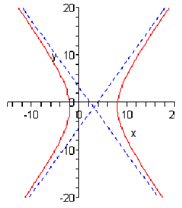
Now we can start the sketching.  We begin by sketching the asymptotes & the vertices.  Once these are done we know what the fundamental shape should look as so we sketch it in ensuring that as x gets large we move in closer & closer to the asymptotes.

Following is the sketch for this hyperbola.
1838_Sketch the graph of hyperbolas.png


Related Discussions:- Sketch the graph of hyperbolas

Math, 4x/y-3x/y+5x/y-x/y

4x/y-3x/y+5x/y-x/y

True inequality, We have to give one last note on interval notation before ...

We have to give one last note on interval notation before moving on to solving inequalities. Always recall that while we are writing down an interval notation for inequality that t

Math, i need help with my math homework

i need help with my math homework

Equation in slope-intercept form, Find an equation of the line containing e...

Find an equation of the line containing each pair of points. Write your final answer in slope-intercept form. (-2,0) and (0,-7)

Division algorithm, Given a polynomial P(x) along degree at least 1 & any n...

Given a polynomial P(x) along degree at least 1 & any number r there is another polynomial Q(x), called  as the quotient , with degree one less than degree of P(x) & a number R, c

Find out the partial fraction decomposition, Find out the partial fraction ...

Find out the partial fraction decomposition of each of the following. 8x 2 -12/( x( x 2 + 2 x - 6) Solution In this case the x which sits in the front is a linear term

Write Your Message!

Captcha
Free Assignment Quote

Assured A++ Grade

Get guaranteed satisfaction & time on delivery in every assignment order you paid with us! We ensure premium quality solution document along with free turntin report!

All rights reserved! Copyrights ©2019-2020 ExpertsMind IT Educational Pvt Ltd