Siting departments for process layout - service operations, Operation Management

Assignment Help:

Siting Departments for Process Layout - Service Operations

In determining the relative position of service departments the costs of movement may be less important than other, less-quantifiable considerations. For example, it may be important for customer reception to be close to the main entrance; it may be desirable to separate customers from back-office staff, or remote from sources of noise; in a hospital, it may be essential that certain departments are close together to deal with emergency cases. In such circumstances the systematic layout planning (SLP) method may be suitable. It will be illustrated by a simple example.
2124_Siting Departments for Process Layout – Service Operations.png

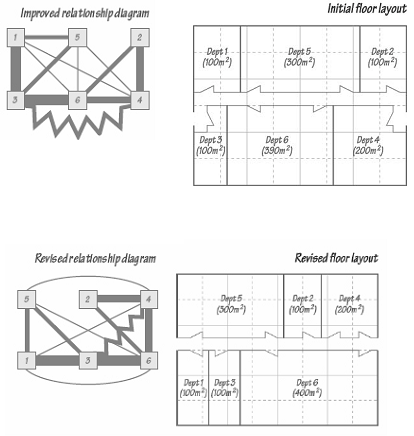
Six departments (1 - 6) are to be laid out on a single floor of a building, shown in the figure above. Making allowances for a 2m-wide corridor between the doors, the net area available for the departments is 1200m2. Having considered the needs of the departments, the allocations are as follows: 1 - 100m2, 2 - 100m2, 3 - 100m2, 4 - 200m2, 5 - 300m2, and 6 - 400m2. 

The next step is to consider each pair of departments and make an assessment of the desirability of them being close to each other. A simple code, which employs the vowels and 'X', is used for rating, with the significance shown in the following table.

SLP rating codes 

Code  Meaning

A  Absolutely necessary 

E  Essential 

I  Important 

O  Ordinary importance 

U  Unimportant 

X   Undesirable

The closeness ratings are presented in a grid, as in the figure above, the ratings being entered at the intersections of rows. For example, the pairing of departments 1 and 3 has the highest rating, 'A', whereas departments 3 and 4 must not be adjacent, 'X'.  

The next step is to draw a relationship diagram, (see figure), which represents the ratings as lines of varying intensity. In this initial diagram the positions may be chosen arbitrarily. The diagram is then scrutinised with a view to amending it to bring the 'A' departments together, and separate the 'X' departments. This figure shows an amendment of the previous relationship diagram to achieve this. Although, in this simple case, a 'good' configuration has been achieved in one step, in more complex circumstances (eg more departments), several iterations may be required to obtain a satisfactory arrangement. We can now try to develop a floor plan, taking into account the space requirements of the departments and the constraints imposed by the building. The figure above shows one of many possible floor plans. A feature of this layout that may be deemed undesirable is the extra space taken up by the dog-legged corridor. In the light of this, further scrutiny of the relationship diagram allows another configuration, shown in these two figures, which might be considered better.


Related Discussions:- Siting departments for process layout - service operations

What are the characteristics of service organisations, What are the charact...

What are the characteristics of service organisations? The characteristics of service organisations are as given below: a. Intangibility for illustrations no physical subs

Explain what is the best production order quantity, Johnson Plastics makes ...

Johnson Plastics makes and sells, among many other things, specialty plastic display cases for retail stores. Johnson's expected demand for the display cases is 1,000 units, and av

Explain implement any change in strategy, 1. Describe how you think the hot...

1. Describe how you think the hotel's management will: (a) make sure that the way it manage the hotel is appropriate to the way it competes for business; (b) implement any change i

What are the potential advantages of profit sharing plan, To compete more e...

To compete more effectively, your organization is considering a profit sharing plan to increase employee effort and to encourage employees to think like owners. What are the potent

Electronic executive information systems, Electronic Executive Information ...

Electronic Executive Information Systems (EIS) and Expert Systems (ES) are examples of  Decision based software.

Information required for process planning, Information required for Process...

Information required for Process Planning Quantity of work to be along with product specifications. Availability of equipment tools and personnel (giving dates e

Explain adaption and culture shock, The first response to unfamiliar surrou...

The first response to unfamiliar surrounds, like those encountered in an overseas assignment, is: Answer: a. Adaption b. Culture shock c. Fascination d. Reverse culture shock

Objectives of work measurement, Objectives of Work Measurement: 1.    ...

Objectives of Work Measurement: 1.       To determine the  standard cost and  as an aid  preparing bidets. 2.        To balance  the crew activities  of those  job requirin

Heterogeneity and intangibility of service products, Heterogeneity and Inta...

Heterogeneity and Intangibility of Service Products Heterogeneity  Service may be variable, difficult to standardise.  Intangibility of service products  Not ea

Write Your Message!

Captcha
Free Assignment Quote

Assured A++ Grade

Get guaranteed satisfaction & time on delivery in every assignment order you paid with us! We ensure premium quality solution document along with free turntin report!

All rights reserved! Copyrights ©2019-2020 ExpertsMind IT Educational Pvt Ltd