Show calculation of project net present value, Financial Accounting

Assignment Help:

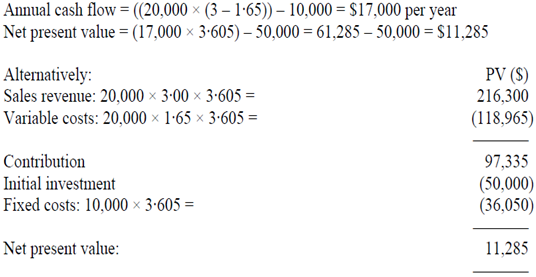
Q. Show Calculation of project net present value?
606_Show Calculation of project net present value.png

Sensitivity of NPV to sales volume

Sales volume giving zero NPV = ((50000/3·605) + 10000)/1·35 = 17681 units

This is a reduce of 2319 units or 11·6%

On the other hand sales volume decrease = 100 × 11285/97335= 11·6%

Sensitivity of NPV to sales price

Sales price for zero NPV = (((50000/3·605) + 10000)/20000) + 1·65 = $2·843

This is a decrease of 15·7c or 5·2%                                                            

On the other hand sales price decrease = 100 × 11285/216300 = 5·2%

Sensitivity of NPV to variable cost

Variable cost should increase by 15·7c or 9·5% to $1·81 to make the NPV zero.

On the other hand variable cost increase = 100 × 11285/118965 = 9·5%

Sensitivity analysis assesses the effect on project net present value of changes in project variables. The purpose is to determine the key or critical project variables which are those where the smallest change produces the biggest change in project NPV. It is restricted in that only one project variable at a time may be changed whereas in reality several project variables may change simultaneously. For instance an increase in inflation could result in increases in variable costs, sales price and fixed costs.

Sensitivity analysis isn't a way of evaluating project risk since though it may identify the key or critical variables it can't assess the likelihood of a change in these variables. Alternatively sensitivity analysis doesn't assign probabilities to project variables. Where sensitivity analysis is helpful is in drawing the attention of management to project variables that require careful monitoring if a particular investment project is to meet expectations. Sensitivity analysis is able to as well highlight the need to check the assumptions underlying the key or critical variables.


Related Discussions:- Show calculation of project net present value

Evaluate the value of non-controlling interest, The additional 20% purchase...

The additional 20% purchase by RBE results is enhancing in the controlling interest held in the subsidiary, DCA. No additional goodwill is calculated on the additional purchase as

Financial information, The enhancing qualitative characteristic of understa...

The enhancing qualitative characteristic of understand ability means that information should be understood by a those who are experts int eh interpretation of financial information

Retirement benefits and why it is shown in annual report, Retirement benefi...

Retirement benefits 1)      Provident fund and family pension: a.       Contribution to PF and PPF are provided for and payments in respect thereof are made to the relevant

Inventory turnover, During 2014, Victoria’s Fashion had beginning inventory...

During 2014, Victoria’s Fashion had beginning inventory of $480,000, ending inventory of $560,000, and cost of goods sold of $2,200,000. Compute the inventory turnover and days’ in

Explain irs, The IRS is conducting a transfer pricing examination of USAco,...

The IRS is conducting a transfer pricing examination of USAco, a wholly-owned U.S. subsidiary of FORco. USAco purchases widgets from FORco for resale in the United States. The IRS

Identifying fixed cost and variable cost, 1. When preparing the operating a...

1. When preparing the operating activities section of the statement of cash flows using the indirect method, a decrease in accounts recievable is subtracted from net income. True o

maximize profit, Natural Furniture Company manufactures three outdoor prod...

Natural Furniture Company manufactures three outdoor products, benches, chairs, and tables. Every product must pass by the following departments before it is shipped: sanding, sawi

Determine npv and expected market return, Using CAPM's formula, Return o...

Using CAPM's formula, Return on equity = Risk-free rate + Beta*(Expected market return - risk-free rate) With the given information, Return on equity = 1% + 0.55*(8% - 1%)

Calculate the optimal allocation of stocks, A) Suppose you have two stocks ...

A) Suppose you have two stocks (A and B) in your portfolio, worth $400,000 and $600,000 respectively. The annual volatility is 0.30 and 0.35 respectively. The correlation between t

Write Your Message!

Captcha
Free Assignment Quote

Assured A++ Grade

Get guaranteed satisfaction & time on delivery in every assignment order you paid with us! We ensure premium quality solution document along with free turntin report!

All rights reserved! Copyrights ©2019-2020 ExpertsMind IT Educational Pvt Ltd