Series solutions to differential equation, Mathematics

Assignment Help:

Before we find into finding series solutions to differential equations we require determining when we can get series solutions to differential equations. Therefore, let's start with the differential equation,

 p (x) y′′ + q (x) y′ + r (x )y = 0                   (1)

Now there we really do mean nonconstant coefficients. For this point we've only dealt along with constant coefficients. Though, with series solutions we can now contain nonconstant coefficient differential equations. As well as, in order to make the problems some nicer we will be dealing only along with polynomial coefficients.

Here, we say that x=x0 is an ordinary point if given both,

q(x)/p(x)                      and                  r(x)/p(x)

Both are analytic at x=x0. It is to say that such two quantities have Taylor series around x=x0. Our aim is only dealing with coefficients which are polynomials thus this will be equivalent to saying as,

p(x0) ≠ 0

If a point is not an ordinary point so we call this a singular point.

The fundamental idea to finding a series solution to a differential equation is to suppose that we can write the solution like a power series in the form,
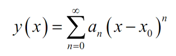
1856_Series Solutions to Differential Equation9.png..................(2)

And then try to find out what the an's require to be. We will only be capable to do this if the point x=x0, is an ordinary point. We will generally say as (2) is a series solution around x=x0.

Let's begin with a very fundamental example of this. Actually this will be so fundamental that we will contain constant coefficients. It will permit us to check that we find the exact solution.


Related Discussions:- Series solutions to differential equation

Explain similar figures in similarity, Explain Similar Figures in similarit...

Explain Similar Figures in similarity ? Similar figures are figures that have the same shape but not necessarily the same size, so the image of a figure is similar to the orig

Example of division of fractions, Example of division of fractions: E...

Example of division of fractions: Example: (4/5)/(2/9) = Solution: Step 1:             Invert the divisor fraction (2/9) to (9/2). Step 2:             Multip

Interval of validity, The interval of validity for an IVP along with initia...

The interval of validity for an IVP along with initial conditions: y(t 0 ) = y 0 or/and y (k) (t 0 ) = y k There is the largest possible interval on that the solution is va

Trigonometry, Ashow that sec^2x+cosec^2x cannot be less than 4

Ashow that sec^2x+cosec^2x cannot be less than 4

Numercial analysis and computer techniques, write FORTRAN programme to gene...

write FORTRAN programme to generate prime numbers between 1 and 100

Direction cosines - vector, Direction Cosines This application of the ...

Direction Cosines This application of the dot product needs that we be in three dimensional (3D) space not like all the other applications we have looked at to this point.

Solid Mensuration, The two sides of a triangle are 17 cm and 28 cm long, an...

The two sides of a triangle are 17 cm and 28 cm long, and the length of the median drawn to the third side is equal to 19.5 cm. Find the distance from an endpoint of this median to

What is pythagorean triples, What is Pythagorean Triples? A set of thre...

What is Pythagorean Triples? A set of three numbers a, b, and c that can satisfy the equation A 2 +b 2 = c 2 , is called a Pythagorean triple. The following is a list of

Assignment help, How do get help with my work? should i just type it in thi...

How do get help with my work? should i just type it in this box...? sorry thanks!

Write Your Message!

Captcha
Free Assignment Quote

Assured A++ Grade

Get guaranteed satisfaction & time on delivery in every assignment order you paid with us! We ensure premium quality solution document along with free turntin report!

All rights reserved! Copyrights ©2019-2020 ExpertsMind IT Educational Pvt Ltd