Risk Breakdown Structure (RBS)
Risk Breakdown Structure (RBS) is a tool developed by Dr. David Hillson that is used to guide the risk management process. He describes RBS as "A Source-oriented grouping of project risks that organise and defines the total risk exposure of the project. Each descending level represents an increasingly detailed definition of sources of risk to the project." (Introduction to IT project management By Cynthia Snyder, Frank Parth).
The Risk Breakdown Structure (RBS) helps a project manager and the risk manager to structure the risks being identified. RBS is considered as the "hierarchically organized depiction of the identified project risks arranged by risk category." The risk data can be arranged in an organised and structured manner to provide standard presentation of the risk data, which help in better understanding, communication and management.
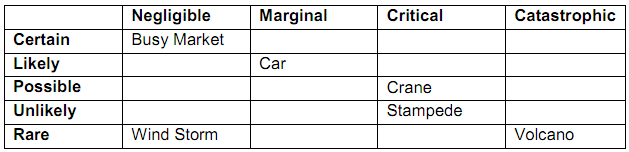
Problem related to the structuring of project risk can be solved by using hierarchical approach with levels that are required to provide essential understanding of tracked risks for effective risk management. This hierarchical structure of potential risk sources is known as a Risk Breakdown Structure (RBS). The RBS arranges the risk items into labelled rows and columns within a table called Matrix. This Risk Matrix is considered as tool used to determine the severity of the risk of an event.
Risk Breakdown Structure (RBS) has proven to be the most useful method when compared to other methods such as listing and tracking risks in the spread-sheets. RBS helps you to have a better knowledge on addressed risks which in turn helps you to get into the depth of each risk.
The Table 2.2 shows an example of how the risks are broken down into a matrix structure:
Table 2.2: Matrix Structure
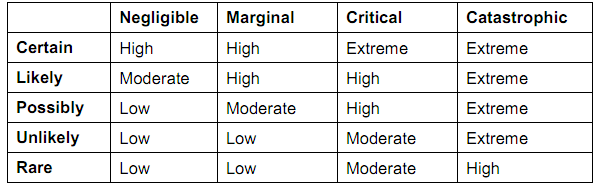
After arranging the tracked risk items in table as matrix form, the company then computes the levels of risk to take with different events. For example, you may face any kind of risks such as having a crane dropped on you, or hit by a car, or the risk of being caught in a stampede. Each risk has probability and a consequence. Probability of being hit by car is more when compared to the risk of being caught in a stampede. However, the consequence of the risk of being caught in a stampede is more terrifying than the risk of being hit by a car. The below Table 2.3 shows the possible risks with their probability and consequence:
Table 2.3: Risk Probability and Consequence