Partial input elasticity of output, Microeconomics

Assignment Help:

Partial Input Elasticity of Output: 

This is a short-run concept which deals with the variability of only one factor keeping the others constant. There are three kinds of returns: 

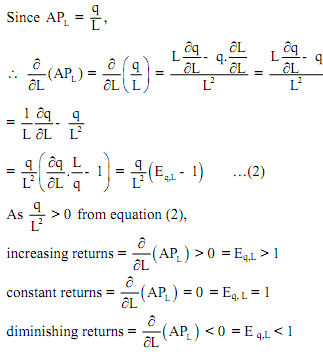
i) Increasing returns: when the AP of a factor rises and MP > AP 

ii) Constant returns: when AP is constant and MP = AP 

iii) Diminishing returns: when AP is falling MP < AP 

The concept of returns to a factor can also be expressed in terms of the "partial input elasticity of output".   

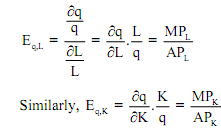
Partial input elasticity of output is also called elasticity of output with respect to a factor. It is the percentage change in output quantity for one per cent change in the quantity of a factor when all other factors remain constant.  

Elasticity of q with respect to L is given by,  
1629_Partial Input Elasticity of Output.png

let us now related this to return to scale
771_Partial Input Elasticity of Output1.png

Besides the above mentioned three returns, there can be another type known as the 'non-proportional returns to a variable factor'. Under it, initially, there is increasing returns to a factor up to a certain level beyond which there is diminishing returns.  


Related Discussions:- Partial input elasticity of output

Determine the benefits of increased openness in trade, The benefits of incr...

The benefits of increased openness in trade. Narrowly defined, trade openness is lowering trade barriers - facilitating increased imports - whereas focusing on international ex

Institutional intervention on deightweight loss, so this question asks for ...

so this question asks for the deadweight loss if an institution decided to provide this service free of charge. I was wondering if this will achieve the socially efficent level or

Private, Question: (a) Using an example, differentiate between private...

Question: (a) Using an example, differentiate between private, social and external costs and benefits. (b) With the use of a diagram, describe the difference between profi

Describe theory of purchasing power parity, Question 1: (a) Using examp...

Question 1: (a) Using examples, explain how the theory of Purchasing Power Parity conforms to the Law of One Price. (b) According to you, how best does the Theory of Purchasing

Deductive and inductive methods, what are the merits and demerits of deduct...

what are the merits and demerits of deductive inductive methods in economic analysis?

Teacher-wellston high school, When the curve that envelops the sweries of p...

When the curve that envelops the sweries of possible short-run average total cost curves is horizontal, this means that they are a. economies of scale, b. dieconomies of scale, co

Monopoly, causes for emergency of monopoly

causes for emergency of monopoly

Structure of the imf, Structure of the IMF: The Central office of the ...

Structure of the IMF: The Central office of the IMF is in Washington DC, USA. It has 184 members. It is affiliated to the UNO. The highest authority of the IMF is the Board of

Long term microeconomics, Igora''s pizzeria want to know if it should stay ...

Igora''s pizzeria want to know if it should stay open this spring. Total Revenue will be $ 12,000 per week and Total Cost will be $ 18,000 per week. The fixed cost of running the b

Write Your Message!

Captcha
Free Assignment Quote

Assured A++ Grade

Get guaranteed satisfaction & time on delivery in every assignment order you paid with us! We ensure premium quality solution document along with free turntin report!

All rights reserved! Copyrights ©2019-2020 ExpertsMind IT Educational Pvt Ltd