Partial derivatives - transistor hybrid model, Electrical Engineering

Assignment Help:

Partial derivatives - Transistor hybrid model:

The partial derivatives are taken by keeping the collector voltage or base current constant as pointed out by the subscript attached to the derivative.

ΔvB , ΔvC ,  Δ iC , Δ iB present the small signal(increment) base and collector voltages and currents, they are presented by symbols   vb , vc , ib and  ic correspondingly. 

 Eqs (3) and (4) may be written like as follow:

             Vb = hie ib + hre Vc                                                                 

              ic = hfe ib + hoe Vc

in which   hie =(∂f1/∂iB)Vc =  (∂vB/∂iB)Vc = (ΔvB /ΔiB)Vc = (vb / ib)Vc         

                  hre =(∂f1/∂vc)IB   =  (∂vB/∂vc) IB = (ΔvB /Δvc) IB = (vb /vc) IB


                hfe  =(∂f2/∂iB)Vc =  (∂ic /∂iB)Vc = (Δ ic /ΔiB)Vc = (ic / ib)Vc

                hoe= (∂f2/∂vc)IB   =  (∂ic /∂vc) IB = (Δ ic /Δvc) IB = (ic /vc) IB

The above equations described the h-parameters of the transistor in CE configuration. Similar theory can be extended to transistors in additional configurations.

Hybrid Model and Equations for the transistor in three dissimilar configurations are displayed below.
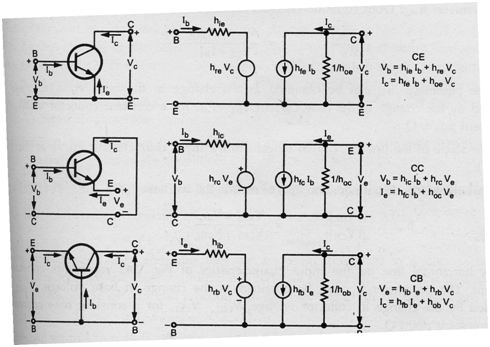
662_Partial derivatives - Transistor hybrid model.png


Related Discussions:- Partial derivatives - transistor hybrid model

Active-mode pnp transistors in circuits, Active-mode PNP transistors in cir...

Active-mode PNP transistors in circuits: In the figure, the arrows showing current point in the direction of conventional current - the flow of electrons is in the opposite di

Single direction pump, Modify the design of the circuit shown in FIGURE and...

Modify the design of the circuit shown in FIGURE and draw a circuit diagram to provide rotary actuation in both directions using a single direction pump (to replace the bi-directio

Linear system to a unit-step excitation, Q. The response v(t) of a linear s...

Q. The response v(t) of a linear system to a unit-step excitation i(t) is given by v(t) = (5 - 3e -t + 2e -2t ) u(t). Determine the transfer function H(s) = V (s)/I (s).

Explain power-system loads, Q. Explain Power-System Loads? Figure repre...

Q. Explain Power-System Loads? Figure represents a one-line (single-line) diagram of a part of a typical three-phase power system. Notice the symbols that are used for generato

Zero flag - registers , Zero Flag - Registers If the  result of any  a...

Zero Flag - Registers If the  result of any  arithmetical  or logical  operation in the accumulator  is zero i ,e  all the bits  of accumulator  ( with  some exceptions )  are

Define combinations of logic gates, Define Combinations of logic gates? ...

Define Combinations of logic gates? The Logic gates be able to combined to produce more complex functions. They can as well be combined to substitute one kind of gate for anoth

Electronics circuits 1, Explain and drive the expression for fixed bias and...

Explain and drive the expression for fixed bias and potential divider.

What are the advantages of using robots, What are the Advantages of using r...

What are the Advantages of using robots -  They are able to work non-stop; they don't need a break -  They are capable of working in conditions hazardous to humans -  Ess

Write Your Message!

Captcha
Free Assignment Quote

Assured A++ Grade

Get guaranteed satisfaction & time on delivery in every assignment order you paid with us! We ensure premium quality solution document along with free turntin report!

All rights reserved! Copyrights ©2019-2020 ExpertsMind IT Educational Pvt Ltd