Packet processing on vpn router, Computer Networking

Assignment Help:

Consider the site-to-site VPN scenario shown in Figure 2. Let's deploy the AH protocol on the two VPN routers so that no desktop on the two sites need to do any AH operations. Assume Alice's desktop is on VPN Site 1 while Bob's desktop is on VPN site 2. Assume the IP address of Alice's desktop is 130.2.3.244; the IP address of Bob's desktop is 166.100.66.2.
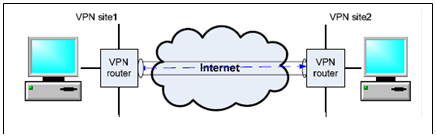
1268_Packet processing on VPN router.png

When Alice sends message "Stock X price $29" to Bob, the message sender program running on Alice's desktop needs to firstly compose the packet. Please draw the whole packet.

 After a while, the packet will arrive at the VPN router on site 1. After the packet is processed by the VPN router according to the AH protocol, it will be sent out from the VPN router. When the packet leaves the VPN router on site 1, what does the packet look like? Please draw the whole packet. Please note that we assume the VPN router does not enforce the ESP protocol - no tunneling.

Let's assume there is a bad guy named Mallory who can intercept this packet in the Internet between these two VPN routers. When this packet is intercepted by Mallory, can Mallory know what the message is? Why?

After a while, the packet will arrive at the VPN router on Site 2. When the packet is processed by the VPN router on Site 2, what will the VPN router do? Please give a step-by-step answer.

To enforce an IP spoofing attack, Mallory will change the header of the packet before it arrives at the VPN router on Site 2. In particular, Mallory will replace the source IP with 130.2.8.3. Can this IP spoofing attack fool the VPN router on Site 2? Why? Note that Mallory will try his best to fake a hash to fool the VPN router.

If the IP spoofing attack mentioned in Question 1.5 is launched by a colleague employee of Alice inside Site 1, Can this IP spoofing attack fool the VPN router on Site 2? Why?


Related Discussions:- Packet processing on vpn router

Explain the transport layer in detail, Explain the transport layer in detai...

Explain the transport layer in detail Transport Layer: Transport layer ensures and controls the end-to-end integrity of data message propagated via the network  amid two devic

Describe essential security services, Problem: (a) Application Layer pr...

Problem: (a) Application Layer protocols can be classified as connection-oriented or connectionless-oriented. i. What do you understand by the term protocol? ii. Give an e

Byte number - transport layer, Byte Number TCP number all data  bytes ...

Byte Number TCP number all data  bytes that  are transmitted  in a connection. Numbering  is independent  in each direction when TCP receives bytes of data  a process. It stor

What are the advantages of star topology, What are the advantages of Star T...

What are the advantages of Star Topology? The advantages of star topology are: a. Relatively easy to configure. b. Simple to troubleshoot c. Media faults are automatic

What is the purpose of configuration files for servers, Question 1: a) ...

Question 1: a) Give three examples of Shells in Linux. b) Differentiate between the Join command and the Paste command in Linux, use an example to support your answer.

Difference between routable and non- routable protocols, What is the differ...

What is the difference between routable and non- routable protocols? Routable protocols can work with a router and can be used to make huge networks. Non-Routable protocols

What is sockets, A socket is an abstraction that shows an endpoint of commu...

A socket is an abstraction that shows an endpoint of communication. Most applications that consciously use TCP and UDP do so by making a socket of the appropriate type and then per

What is fiber distributed data interface, FDDI -(Fiber Distributed Data Int...

FDDI -(Fiber Distributed Data Interface) FDDI Basics: FDDI (Fiber Distributed Data Interface) came about because system managers became concerned with network reliability i

Link layer process, Each link layer process will have two connections: one ...

Each link layer process will have two connections: one "up" to the appropriate IP layer process, and one "sideways" to the link layer process on the simulated machine at the other

Write Your Message!

Captcha
Free Assignment Quote

Assured A++ Grade

Get guaranteed satisfaction & time on delivery in every assignment order you paid with us! We ensure premium quality solution document along with free turntin report!

All rights reserved! Copyrights ©2019-2020 ExpertsMind IT Educational Pvt Ltd