Nickel cadmium batteries -construction, Physics

Assignment Help:

Nickel cadmium batteries -Construction:

The plates of a nickel cadmium battery are made by sintering a nickel plated steel screen with nickel carbonyl powder. The resultant plaques are then impregnated with the active materials, Nickel salts on the positive, cadmium salts on the negative. The plaques are then placed in electrolyte and subjected to a small current to convert them to their final form.

After washing and drying the plaques are cut into plates, each one having a nickel tab welded to it. The plates are then stacked alternately to produce a cell.

Whilst producing the stack a continuous separator is wound between the plates to prevent them shorting.

Terminals are then welded to the plates and the stack up is inserted into its container, which is sealed and pressure tested.
The separator used is normally a triple layer type, one layer of cellophane, two of woven nylon cloth. Cellophane is used because it has a low resistance and is a good barrier material, it prevents metal particles from shorting the plates whilst allowing current to flow. The cellophane also acts as a gas barrier, preventing oxygen given off by the positive plate during overcharge, from passing to the negative plates. At the negative plates the oxygen combines with the cadmium, reducing the cell voltage and producing heat.

The electrolyte, a solution of potassium hydroxide and distilled water, with a SG of between 1240 and 1300, is then injected into the cell under a vacuum. Fitted to the top of each cell is a special vent that allows the escape of gas but prevents electrolyte spillage.
1535_Nickel cadmium batteries.png

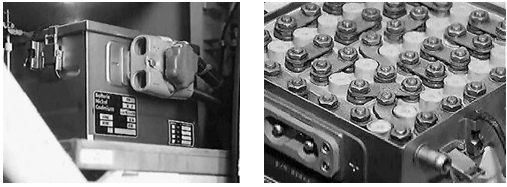
In a typical Ni Cad battery the cells are mounted in a metal case that incorporates 2 venting outlets, carrying handles, a quick release connector and a lid. Each cell is separated from its neighbour by its moulded plastic case and electrically connected by nickel plated steel links between the terminals.


Related Discussions:- Nickel cadmium batteries -construction

Give the applications of moseley''s law, Q. Give the applications of Mosele...

Q. Give the applications of Moseley's law. (i) The elements are organized in the periodic table according to the atomic numbers and not according to the atomic weights. (ii

Mechanics, if acceleration vs time graph is given then how to calculate dis...

if acceleration vs time graph is given then how to calculate displacement

Whta is mach number , Mach number is the ratio of velocity of source to the...

Mach number is the ratio of velocity of source to the velocity of sound.        Mach Number = Velocity of Source / Velocity of Sound  .

Characteristic of a photodiode, a) Sketch an IV characteristic of a photodi...

a) Sketch an IV characteristic of a photodiode, showing how the curve shifts as a result of the illumination intensity incident on the device being varied. b) Indicate on the c

Define grating element, Q. Define: grating element. The combined width ...

Q. Define: grating element. The combined width of a slit as well as a ruling in a plane diffraction grating is called as a grating element.

What distance does the cheetah cover, A cheetah can accelerate from rest to...

A cheetah can accelerate from rest to a speed of 27.8 m/s in 5.20 s. The cheetah can carry this speed for 9.70 s before it quickly runs out of energy and stops. What distance does

Sound, experiments on how sound waves travel faster in iron

experiments on how sound waves travel faster in iron

Can you explain single slit diffraction, Can you explain in single slit dif...

Can you explain in single slit diffraction intensity of 1 st secondary maximum is less than that of principal maximum by how many times?

Write Your Message!

Captcha
Free Assignment Quote

Assured A++ Grade

Get guaranteed satisfaction & time on delivery in every assignment order you paid with us! We ensure premium quality solution document along with free turntin report!

All rights reserved! Copyrights ©2019-2020 ExpertsMind IT Educational Pvt Ltd