Multiplication of binomials, Mathematics

Assignment Help:

To understand the multiplication of binomials, we should know what is meant by Distributive Law of Multiplication. Suppose that we are to multiply (a + b) and m. We treat (a + b) as a compound expression and m as a simple expression.  Therefore,  (a + b)m by definition will be:

         =       m + m + m + m + ....... taken a + b times

         =       (m + m + m + .... taken a times) + (m + m + m + ..... taken b times)

         =       am + bm

Similarly (a - b)m = am - bm and (a - b + c)m = am - bm + cm. This is referred to as Distributive Law of Multiplication and it says that the product of a compound expression by a simple expression is the algebraic sum of the partial products of each term of the compound expression by that simple expression.

         In the above, if we write (c + d) in place of m we will have

         (a + b)(c + d)    =              a(c + d) + b(c + d)

                                =              ac + ad + bc + bd

1. Multiply (3a + d) and (b + c).

We employ (a + b)(c + d) = a(c + d) + b(c + d)   = ac + ad + bc + bd. Therefore, (3a + d)(b + c)   = 3a(b + c) + d(b + c) = 3ab + 3ac + bd + cd. (This procedure can be extended to trinomials and polynomials also.)

2. Multiply 2a + 5c and 3d + 2b.

         One way of doing this is to employ (a + b)(c + d) = ac + ad + bc + bd

         That is,

         (2a + 5c)(3d + 2b) = 2a(3d + 2b) + 5c(3d + 2b)

                                   = 6ad + 4ab + 15cd + 10bc

In the second method, we position the binomials as we did in addition or subtraction and do the multiplication operation. That is,

                                      2a + 5c

(x)

3d + 2b


6ad + 15cd


+ 4ab  + 10bc


6ad + 15cd + 4ab + 10bc

This product is the same as one obtained earlier.

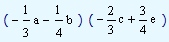
Multiply 1180_multiplication of binomials.png and 37_multiplication of binomials2.png

That is, we have to compute

1242_multiplication of binomials3.png

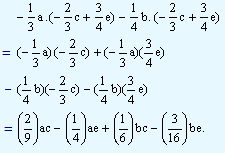
We write this as

1089_multiplication of binomials4.png 

(Note: While multiplying fractions, numerators and denominators of given fractions are multiplied respectively and the product also being expressed as a fraction.)

  1. Add 3ac + 5bd - 7cd and ac - 5bd - 4cd

  3ac + 5bd - 7cd

(+)

ac - 5bd - 4cd
  4ac +  0  - 11cd
  1. Multiply 3a + 5b - 7d and c - 4e - 5

That is, we require (3a + 5b - 7d) x (c - 4e - 5)

= 3a (c - 4e - 5) + 5b (c - 4e - 5) - 7d(c - 4e - 5)

= 3ac - 12ae - 15a + 5bc - 20be - 25b - 7cd + 28de + 35d


Related Discussions:- Multiplication of binomials

Chp 8 Study, Center and Radius 1)(x+2)^2-(y-3)^2=4

Center and Radius 1)(x+2)^2-(y-3)^2=4

Lower than average, A local police precinct has seen a recent enhance in th...

A local police precinct has seen a recent enhance in the number of complaints filed regarding how officers are interacting with the public. Before addressing the issue, the command

Percents, If 2/3 of a number is 24 then 1/4 of a number is...

If 2/3 of a number is 24 then 1/4 of a number is...

Please help me solve these Problems step by step, What angle (to the neares...

What angle (to the nearest degree) corresponds to the cos 0.6 or what is cos-1(0.6)? (Note: Use Appendix I) What angle (to the nearest degree) corresponds to the sin 0.6 or what

Learning to count in maths, Here we learn: 1) Discussed what counting me...

Here we learn: 1) Discussed what counting means, and stressed that it is not the ability to recite number names. 2) Talked about the need for a child to understand several pr

Exponential and logarithm equations, Exponential and Logarithm Equations ...

Exponential and Logarithm Equations : In this section we'll learn solving equations along with exponential functions or logarithms in them. We'll begin with equations which invol

Prisoners dilemma, Prisoners Dilemma This is a type of non-zero sum gam...

Prisoners Dilemma This is a type of non-zero sum game and derives its name from the given story: The district attorney has two bank robbers in separate cells and offers them

Law of Iterative Expectation, #quesSuppose we have a stick of length L. We ...

#quesSuppose we have a stick of length L. We break it once at some point X ~ Unif(0;L). Then we break it again at some point Y ~ Unif(0;X). Use the law of iterated expectation to c

Write Your Message!

Captcha
Free Assignment Quote

Assured A++ Grade

Get guaranteed satisfaction & time on delivery in every assignment order you paid with us! We ensure premium quality solution document along with free turntin report!

All rights reserved! Copyrights ©2019-2020 ExpertsMind IT Educational Pvt Ltd