Machine and tool selection , Mechanical Engineering

Assignment Help:

Machine and Tool Selection

The quality of a product largely depends on the type of machine, the type of process, machining conditions and the right selection of tools. The current trend in manufacturing is to adopt more and more of automation of the fixed and flexible type. Hence, with a machine tool of a given level of automation the scope for improving productivity lies more and more in the selection and application of cutting tools.

Some of the factors influencing the selection of cutting tool are properties of tool materials, properties of work materials, the type of process, the accuracy and surface finish required, the cutting conditions, tool wear and tool life. The properties of tool material include Hardness, strength, Stiffness and Resilience, Wear resistance, Low coefficient of friction, Thermal Conductivity and Specific Heat. Some important tool materials used are High Carbon Steels, High Speed Steels, Cast Cobalt (Stellite) Tools, Carbides, Coated Carbides, Ceramics, Diamonds, Cubic Boron Nitride(CBN), Polycrystalline Diamond.

The important properties influencing the selection of cutting tools are : Hardness, Tensile strength, Modulus of elasticity, Chemical composition, Micro structure, Strain hardenability and thermal conductivity. The type of the manufacturing process depends upon the type of the tools used. Basically the tools can be classified into two types generating tools and forming tools. At the time of process planning the tools are selected depending on the accuracy and surface finish required. This is because of the fact that different operations and different tools would produce different accuracy levels and surfaces.

The tool life equation as proposed by Taylor is VTn = C

where  n = Constant for tool material,

V = Cutting speed, m/min, and

T = Tool life in min.

As this formula doesn't take into account all the effecting parameters, many researchers have extended this formula.

TQB = C

Equation 2
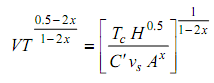
1229_Machine and Tool Selection.png

where  H = Specific heat × thermal conductivity,

θ = Tool temperature,

A = Area of cut,

us = Specific cutting energy/unit cutting force, and

C and x are constants.

VTnn1, dn2 = C         . . . (3)

where  f = Feed, mm/rev.,

d = Depth of cut, and

C = Constant.

All the cutting tools used in lathe are single point tools. The single point cutting tool nomenclature comprises the various parts of tool and systematic arrangement of tools angles. The tool angle are normally specified in the sequence of Back rake, Side rake, End relief, Side relief, End cutting edge, Side cutting edge angles and Nose radius. The various operations performed on a lathe machine are centering, turning, facing, thread cutting, knurling, parting off, forming, drilling, boring, and reaming. Similarly this unit discusses about the other type of tools used in milling and drilling.


Related Discussions:- Machine and tool selection

Longitudinal stress in the plate section through the rivets, A steam boiler...

A steam boiler, 3 m in diameter, is made of 25 mm thick mild steel plates. The efficiency of longitudinal riveted joint is 88% and that of circumferential riveted joint is 70%. Cal

Give expressions for work done and efficiency for otto cycle, Draw neat dia...

Draw neat diagram of aWankel engine and explain its working. Derive expressions for work done and efficiency for an Otto cycle. Illustrate with diagrams the several types of

Surface preparation and coating, Q. Surface Preparation and Coating? Ve...

Q. Surface Preparation and Coating? Vendor shall chemically clean all foreign material and commercially sandblast (SSPC-SP-10) mill scale and rust from all surfaces to be paint

Find the stress developed in copper and steel, A steel rod of 20 mm diamete...

A steel rod of 20 mm diameter passes centrally through a copper tube of 50 mm external diameter and 40 mm internal diameter. The tube is closed at each end by rigid plates of negli

Work - thermodynamics, Work - thermodynamics: The work can be defined ...

Work - thermodynamics: The work can be defined as follows: "Work is defined as energy transferred across the boundary of a system due to an intensive property difference ot

Determine the critical load, Determine the critical load (W crit ) to ...

Determine the critical load (W crit ) to cause elastic instability of the rigidly jointed frame shown in Figure Q2. The frame members have constant bending stif

What are the several factors affecting tool life, (a) Draw a single point c...

(a) Draw a single point cutting tool and label clearly the several parts of it. Illustrate them in brief. (b) What are the several factors affecting tool life ? (c) List char

Explain what is meant by the nanocomposite, Choose either a plastic, compos...

Choose either a plastic, composite, titanium alloy or aluminium alloy for the applications below and briefly explain your choice. In explaining your choice, relate the properties t

Explain clamping devices, Explain Clamping Devices A clamp is a d...

Explain Clamping Devices A clamp is a device that holds the work piece firmly against the locators provided and also resists all forces generated by the cutting action of

Kinetics, Kinetics: Define Kinetics. What is plane motion? Sol: ...

Kinetics: Define Kinetics. What is plane motion? Sol: Kinetics is that branch of mechanics, which deals with force system that produces acceleration and resulting motio

Write Your Message!

Captcha
Free Assignment Quote

Assured A++ Grade

Get guaranteed satisfaction & time on delivery in every assignment order you paid with us! We ensure premium quality solution document along with free turntin report!

All rights reserved! Copyrights ©2019-2020 ExpertsMind IT Educational Pvt Ltd