Life in Atmosphere:
Just like the earth, the atmosphere also sustains life. Various types of insects and mites, birds, bats and other organisms are some of the forms that you all might have seen. They effectively use air as a medium for several of their activities, such as, flying and catching their prey. Organisms like bats and birds are skilled aeronauts. In order to remain in the air, they have developed wings and powerful muscles to move them. Some of the birds have very good eyesight. They also have other well developed structures such as claws etc. for grabbing and holding their prey. Have you ever seen large birds like an eagle, catching small birds flying in the air? It is worth watching.
The eagle comes flying from a distance, dives at great speed and pounces on the prey, holds it firmly in its claws and flies away to a quiet place, to sit and eat it. Birds usually fly too close to the land in search of food, but sometimes, they even fly at heights of about 1500 metres. The migratory birds that travel long distances while moving from one continent to the other, fly at an unbelievable height of about 6000 metres. They come to this height, to take advantage of the winds that are usually stronger and steadier there, than those at lower altitudes. These birds fly along the wind currents, and thus save a lot of energy and effort. Besides the large organisms that we can see with our naked eyes, the air also cames a very large variety of life forms that we can only see with the help of a microscope. Spores of plants such as fungi, mosses, ferns, pollen grains of various types, bacteria and viruses are also found floating in the air.
Also there are tiny seeds of many plants. The presence of fungal spores in the air can be demonstrated by leaving a piece of bread in open for a few days. It would show small, sometimes velvety patches of various colours. All these are fungi of various kinds, whose spores were floating in the air, and have started growing on the bread. Similarly, in places, where there are no human settlements nearby, we find small plants of different types occumng in groups. And also, soon after volcanic eruption, when the lava cools, many kinds of plants appear on this lava. You may wonder how did these plants amve here. Their seeds or spores that are present in air, establish on these new areas where favourable conditions for growth are avmlable, and they form small groups.
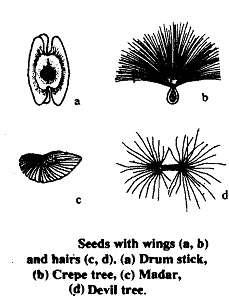
The fungi and other plants whose spores or seeds are carried by the air, produce in huge numbers so that at least a few of them can reach places where the righ1,kind of conditions for growth, such as water, sunlight etc. are available and these seeds or spores are, able to develop into adult plants. This is an adaptation to ensure the survival of species. Seeds which are dispersed by wind have special features such as hairs on their surfaces, wing-like structures and light weight. Having well developed mechanisms to float in air, some of the spores, seeds or pollen grains are taken to great heights by the air currents. So one can also find life forms even at great height. You may have noticed sometimes, that some people are suddenly seized with a fit of sneezing, watery eyes, rash on the skin and even difficulty in breathing. This condition is referred to as allergy. What causes it? Some forms of allergy are caused by certain spores or pollen present in the air, that cannot be seen with unaided eye. Hay fever - a form of allergy, develops by inhalation of pollen of certain trees, grasses or weeds. All these are carried by wind and affect the sensitive persons. Having talked of some physical features of atmosphere and the kind of life it sustains, we shall now briefly discuss the kind of damage done to this ecosystem.