Lead times of scientific development, Science

Assignment Help:

Lead Times of Scientific Development:

When we compare the current status of scientific development and technological fall-out from the same, we find that the lead time of scientific discovery and its applications is much shorter in  the developed countries. This is because of thelr constant efforts  of research and development for technology upgradation which, unfortunately, have been  lacking in our country. It is to be admitted that evy  in developed countries there is a wide variation in the lead times of different discoveries.
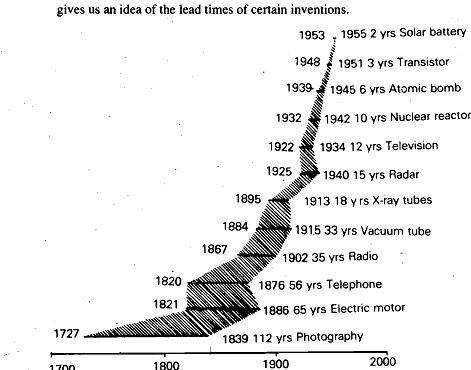
 

1351_Lead Times of Scientific Development.png

These lead times may be quite long in certain cases and quite short in others. For example, aluminium was first obtained in pure form in 1825 and lt was only in  1886 that the process of  its large scale production was finali5ed. The lead time in  this case was 60 years. On the other hand, the process of hydrogenation of  oil in the manufacture of vanaspati originated in 1905, and by 1911 Procter and Gamble Company, U.S.A.  had placed its hydrogenated cotton seed oil, which is similar  to vanaspati, on the market. As you can see, the lead time in  this case was very short: only 6 years.  

The lead times of scientific discovery and its applications in  the field of computers have been among the shortest. One can, therefore, say that the application of any scientific .  discovery relates to the needs, or compulsions of the situation. It is also a fact, that this depends, to a large extent, on the state of industrial development  of the nation and the priority given by  the nation to that particular area. From the This was possible as appropriate  facilities were created, resources were made available, and scientific responsibility clearly given to an , organisation. On the other hand, in agricultural technology, 


Related Discussions:- Lead times of scientific development

Explain myocardium, Explain Myocardium Myocardium :- The middle layer...

Explain Myocardium Myocardium :- The middle layer of the heart wall.

Explain granite, What is granite? Granite is a solid, igneous rock. It ...

What is granite? Granite is a solid, igneous rock. It is formed by mica, quartz, feldspar and sometimes bits of other rocks as well. Granite is generally pink, white, or grey..

Explain the anterior pituitary, Explain the Anterior Pituitary The ante...

Explain the Anterior Pituitary The anterior pituitary gland or adenohypophysis consists of three types of cells - acidophils, basophils and chromophores according to their stai

Microscope, explain the parts of the microscope

explain the parts of the microscope

Explain thiamin (vitamin b1), Thiamin (vitamin B1) Thiamin was  first  ...

Thiamin (vitamin B1) Thiamin was  first  isolated  in  1926 from rice polishing by  Jansen  and Donath.  Its empirical formula was established  in  1931  by  Windaus  and  co-w

Determine about the capillary forces, Determine about the Capillary forces ...

Determine about the Capillary forces Capillary forces are observed in all moist soils, however, the rate of movement and the rise in height may sometimes be less than one would

What is ergonomics, Question 1 Define Epidemiology. Explain the types of e...

Question 1 Define Epidemiology. Explain the types of epidemiological studies with suitable examples Question 2 Discuss the various levels in the Indian healthcare delivery sy

The celestial equator, What constellations does the ecliptic pass by?  Wher...

What constellations does the ecliptic pass by?  Where is the Celestial Equator (in relation to the planets & the ecliptic)?  Are the planets east /west of your local meridian?  Whe

Classifying living things, characteristics which help classify the members ...

characteristics which help classify the members of the protozoan kingdom

Write Your Message!

Captcha
Free Assignment Quote

Assured A++ Grade

Get guaranteed satisfaction & time on delivery in every assignment order you paid with us! We ensure premium quality solution document along with free turntin report!

All rights reserved! Copyrights ©2019-2020 ExpertsMind IT Educational Pvt Ltd