Lead acid batteries, Physics

Assignment Help:


Lead acid batteries:

Lead acid cells have a nominal voltage of 2 Volts, therefore a typical 24V aircraft battery would consist of 12 cells connected in series. The active material in the positive plates is Lead Peroxide (Pb02) the negative plates, Spongy Lead (Pb). The electrolyte is dilute sulphuric acid (2H2SO4).

Construction:
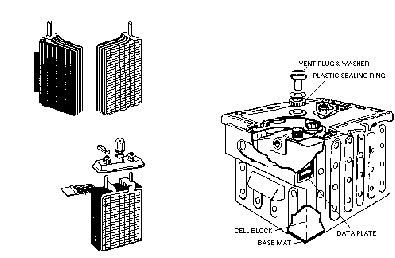
1275_Lead acid cells.png

There are two forms of Lead Acid battery construction, conventional and solid block, often referred to as a Varley type battery.

In the conventional battery the plates consist of lead grids into which the active materials are pressed. The positive and negative plates are then interleaved and connected to a lug that forms both a mechanical support and the terminal.

Cells are generally constructed with an additional negative plate, making both outside plates negative. This ensures that chemical action takes place on both sides of each positive plate. When chemical action only takes place on one side of a positive plate it tends to buckle.  

The plate arrangement is then inserted into a composite material container which is fitted with a lid. The inside of the container is ribbed to provide additional support for the plates, which are raised clear of the bottom of the container to prevent shorting by any sediment that forms.

To provide further support for the plates and to ensure they cannot touch, separators are fitted, these were originally cedar wood but modern batteries use micro-porous plastic materials.

Each cell is fitted with a special non spill valve that allows gasses to escape, but prevents the spillage of electrolyte, this valve can be removed for checking and adjusting the electrolyte level.

The electrolyte used is sulphuric acid diluted with pure distilled water, the specific gravity of the electrolyte used is determined by the manufacturer, however, it is generally lower than 1300.


Related Discussions:- Lead acid batteries

Dynamics of circular motion:force on the particle, FORCE ON THE PARTICLE: F...

FORCE ON THE PARTICLE: For a mass m to have acceleration, a force given by F = ma is always required. In uniform circular motion, acceleration is of value v2/t and is directed tend

LAW OF CONSERVATION OF MOMENTUM, EXPLAIN ROADS SAFETY MEASURES USING THE L...

EXPLAIN ROADS SAFETY MEASURES USING THE LAW OF CONSERVATION OF MOMENTUM

Homework help, Describe an actual situation that would give rise to the fre...

Describe an actual situation that would give rise to the free body diagram

Who discovered proton, Who discovered Proton? In 1886 Eugen Goldstein d...

Who discovered Proton? In 1886 Eugen Goldstein discovered canal rays (also called as anode rays) and showed that they were positively charged particles (ions) formed from gases

Condesed matter, sodium metal with a body centred cubic structure has two a...

sodium metal with a body centred cubic structure has two atoms per unit cell. the radius of sodium atom is 1.85 å. calculate its electrical resistivity at 0 oc, if the classical va

Physics, A train consists of a 4300-kg locomotive pulling two loaded boxcar...

A train consists of a 4300-kg locomotive pulling two loaded boxcars. The first boxcar has a mass of 12,700 kg and the second has a mass of 16,300 kg. Presume that the boxcar wheels

Calculate the torque, A painter uses a 25.8-cm long screwdriver to pry the ...

A painter uses a 25.8-cm long screwdriver to pry the lid off of a can of paint. If a force of 85 N is applied to move the screwdriver 60.0° from the perpendicular, calculate t

Write Your Message!

Captcha
Free Assignment Quote

Assured A++ Grade

Get guaranteed satisfaction & time on delivery in every assignment order you paid with us! We ensure premium quality solution document along with free turntin report!

All rights reserved! Copyrights ©2019-2020 ExpertsMind IT Educational Pvt Ltd